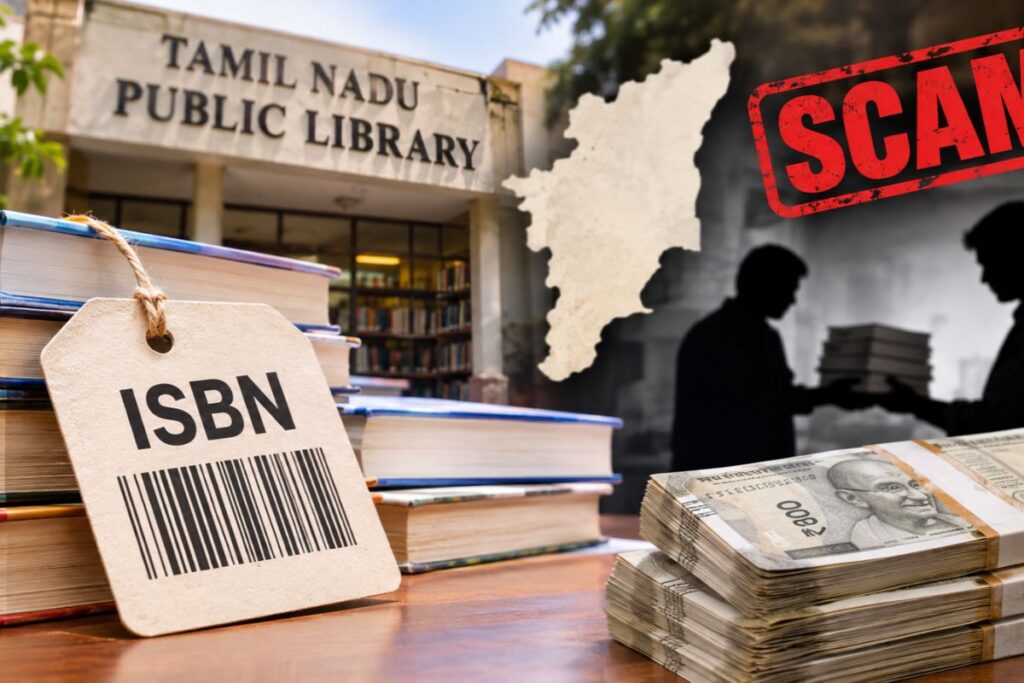
Printing a 200-page black-and-white paperback in India costs roughly ₹130 to ₹160 per copy in small digital runs, while zero-royalty AI text eliminates editorial expenses. In the Tamil Nadu library book scam, four publishers paired free bulk ISBNs with short-run digital printing to turn flat-rate government tenders into a ₹1.74 crore payout across 1,857 titles.
How Much Does It Cost to Print a Fake AI Book for a Government Tender?
Producing a 200-page black-and-white paperback through short-run digital printing in India costs approximately ₹130 to ₹160 per copy for a 50-copy batch, according to October 2026 Indian publishing cost estimates.
The financial mechanics of the Tamil Nadu library book scam rest on that low production floor. According to Directorate of Vigilance and Anti-Corruption (DVAC) submissions before the court, four imprints, Agal Vilakku Publications, Phoenix Publications, Sigma, and Vidya, received ₹1.74 crore for 1,857 titles ordered for public libraries. That averages roughly ₹9,370 in state payouts per title.
Comparing standard Indian print-on-demand (POD), a digital printing method that produces small batches of books only after an order is placed, against traditional publishing expenses shows how the margin works:
- Text generation and editing: ₹0 in author royalties and ₹0 in human copyediting when automated AI tools and template covers replace writers and editors.
- Short-run digital printing: Published 2026 Indian printing estimates place a 200-page black-and-white paperback at ₹130 to ₹160 per copy for a 50-copy run, while platforms like Pothi.com quote ₹91.20 per copy for 50 or more copies of a 100-page paperback.
- State procurement pricing: The Tamil Nadu Directorate of Public Libraries calculates book rates using a standardized price-per-page formula, as noted in the November 16, 2026 Madras High Court order in Ramasubbu v. K. Gopal, IAS.
Multiply that per-copy spread across 1,857 distinct titles, and the math becomes plain. The scheme did not rely on advanced technology; it relied on hitting a standardized government price ceiling with the lowest possible production cost.
How Do Publishers Get Thousands of Free ISBNs in India Without Content Checks?
Publishers in India can obtain blocks of 10, 100, 1,000, or 10,000 free ISBNs online from the Raja Rammohun Roy National Agency (RRRNA) without submitting manuscripts for editorial review or authorship verification.
To qualify for public library procurement in Tamil Nadu, every title needs an International Standard Book Number (ISBN), a 13-digit numeric identifier used by booksellers, libraries, and distributors to catalog specific editions. In India, these numbers are issued by the Raja Rammohun Roy National Agency (RRRNA), a wing of the Ministry of Education that administers the national ISBN registry.
According to the RRRNA’s official portal guidelines, an Indian publishing entity only needs business registration proof, such as a Corporate Identification Number (CIN) or MSME Udyog Aadhaar, and an online self-indemnification to register. As of November 2026, the agency has issued more than 5.84 million ISBNs across 111,725 registered users.
The RRRNA is not a literary regulator, and nothing in the public record suggests the agency was complicit in the fraud. An ISBN serves strictly as a bibliographic product identifier for trade and cataloging, not a certification of copyright, quality, or authorship. Requiring a government office to vet every Indian manuscript before assigning an ISBN would stall legitimate publishing and amount to pre-publication censorship.
Yet when a state procurement system treats an ISBN as proof of a market-tested book, that administrative gap becomes an open door.
Why Do Flat-Rate Library Tenders Reward Volume Over Editorial Quality?
Flat-rate public library tenders pay the same per-page price for an unedited, zero-royalty AI manuscript as they do for a deeply researched, human-edited book, removing any financial penalty for cutting editorial costs to zero.
Under Tamil Nadu’s public library procurement framework, book prices are worked out primarily by physical specifications, including price per page, rather than editorial investment. Legitimate independent Tamil publishers absorb high upfront costs before a single copy is printed: author advances, translation, fact-checking, proofreading, and layout.
Standardized rate cards were designed for a clear administrative purpose: they prevent arbitrary price favoritism, simplify statewide budgeting, and let small regional publishers participate without complex competitive bidding. In practice, however, flat-rate pricing creates an arbitrage opportunity for any vendor willing to flood the tender with high-volume, zero-editorial titles.
How Did Print-on-Demand Remove the Old Barrier to Fake-Title Scams?
Digital print-on-demand eliminated the high setup costs and 500-to-1,000-copy minimum print runs of traditional offset printing, allowing publishers to submit thousands of fabricated titles and print only the exact quantities ordered by the state.
A decade ago, submitting 1,857 fake AI books to a state library tender would have been financially unviable. Offset printing, the industrial process that transfers ink from custom metal plates onto paper, requires heavy upfront capital and large minimum runs to bring unit costs down.
Modern digital print-on-demand changed that supply-chain math. Commercial printers can produce runs as small as 50 copies without metal plate setup, letting a vendor wait for a confirmed government purchase order before printing a single book.
Commercial print-on-demand operators are neutral service providers who print customer-supplied files on order. They hold neither the legal mandate nor the technical capacity to fact-check or plagiarism-test every manuscript that arrives at their presses. Still, the technology erased the capital barrier that once kept mass fake-title submissions out of government tenders.
Why Must Tamil Nadu’s New Procurement Policy Fix Incentives, Not Just AI Detection?
AI-detection software alone cannot stop future library procurement fraud unless Tamil Nadu’s new policy enforces author-identity verification, public disclosure of purchase orders, and structural reforms to flat-rate pricing.
Following the November 2026 DVAC arrest of publisher R. Mohan and court filings alleging fictitious authorship and collusion, the Madurai Bench of the Madras High Court ordered the state to replace its non-binding 2024 guidelines with an enforceable procurement policy within eight weeks.
In its November 16, 2026 order in Ramasubbu v. K. Gopal, IAS, the court outlined concrete structural safeguards. Every supplying publisher must provide a legally enforceable undertaking certifying that each named author is a real, identifiable person who authorized publication. The court also directed the Directorate of Public Libraries to maintain a public database disclosing every book’s ISBN, author, printed price, negotiated price, discount, and payment dates.
As long as free bulk ISBNs, zero-capital print-on-demand, and flat-rate page-count pricing remain intact, vendors can still manufacture low-cost filler books, with or without AI, to capture guaranteed state margins. Whether Tamil Nadu’s new policy enforces those transparency and authorship rules, or merely adds an AI-screening layer to an unchanged pricing formula, will decide if this arbitrage stays closed.
Frequently Asked Questions
How much does it cost to print a 200-page paperback in India using print-on-demand?
According to October 2026 Indian publishing cost estimates, printing a standard 200-page black-and-white paperback in a 50-copy print-on-demand batch costs roughly ₹130 to ₹160 per copy. Shorter 100-page paperbacks cost as little as ₹91.20 per copy for 50 or more copies on Indian print-on-demand platforms like Pothi.com.
Does the RRRNA verify book content or authorship before issuing an ISBN in India?
No. The Raja Rammohun Roy National Agency (RRRNA) issues free ISBNs in blocks of 10 to 10,000 numbers to registered Indian publishers based on business identity proof and an online self-indemnification. An ISBN is strictly a bibliographic catalog identifier, not a certification of authorship or editorial quality.
How did four publishers make ₹1.74 crore in the Tamil Nadu library book scam?
According to DVAC court submissions, four imprints, Agal Vilakku Publications, Phoenix Publications, Sigma, and Vidya, received ₹1.74 crore for 1,857 titles ordered for public libraries, averaging about ₹9,370 per title. By using zero-royalty AI text, free bulk ISBNs, and short-run digital printing, they kept production costs far below the state’s standardized per-page procurement payout.
What safeguards did the Madras High Court order for Tamil Nadu’s public library procurement?
In its November 16, 2026 order in Ramasubbu v. K. Gopal, IAS, the Madras High Court directed that every publisher must submit a legally enforceable undertaking certifying that each named author is a real, identifiable person. The court also called for a public database listing every procured book’s ISBN, author, printed price, negotiated price, discount, and payment timeline.

Praseetha K
Praseetha K is the Managing Editor of Clarity Times. She edits, verifies and publishes the newsroom's articles, and also writes analysis on policy, law, business and technology. Articles she writes are edited by the Editor-in-Chief before publication.