At Clarity Times, we examine what mainstream narratives omit. This dispatch investigates institutional incentives, policy fine print, and multi-dimensional community impacts.
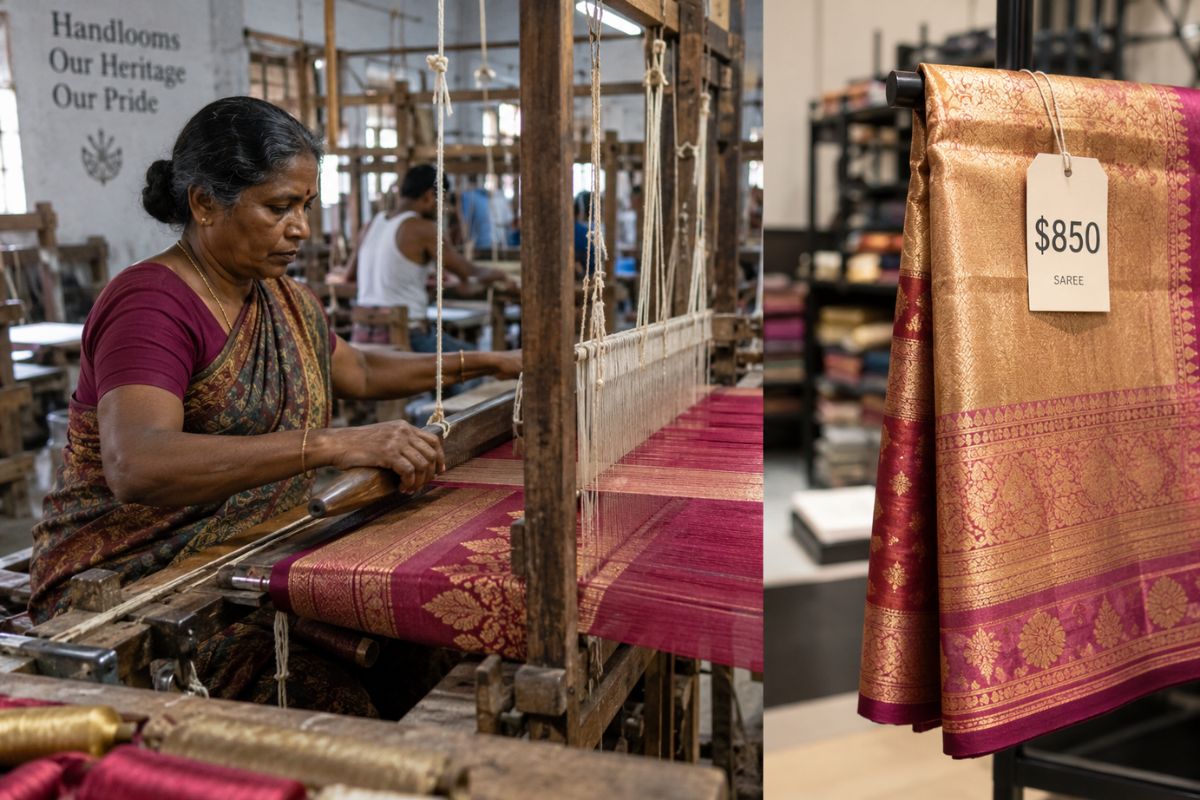
An authentic Indian handloom silk saree sold in a New York boutique for $850 yields the master weaver in India roughly $45. Tracking Indian handloom weavers’ income across the supply chain shows artisans take home 5.2 to 6.8 percent of the retail price. Credit intermediaries and overseas markups absorb three-quarters of the gross value.
Comprehensive analysis and verified data remain essential for understanding complex market dynamics.
Clarity Times Research
How much do weavers make on a $850 Banarasi silk saree?
A genuine Banarasi silk saree retailing for $850 in the US yields a wage of just $38 to $50 for the weaver. South Asian luxury retail boutiques in the United States routinely price these export-grade garments between $750 and $950.
According to wage studies and cooperative passbooks-financial ledgers tracking individual artisan output-Varanasi weavers earn between ₹3,200 and ₹4,200 to produce these specific weaves.
At current exchange rates, that equals $38 to $50 for a garment requiring 12 to 16 days of manual loom labor. This effective hourly return falls strictly below India’s statutory minimum wage for skilled labor.
Does global diaspora demand improve Indian handloom weavers’ income?
Global diaspora demand does not directly improve weavers’ wages, as fixed piece-rate structures prevent overseas markups from reaching the village level. Recent diaspora events in Manhattan showcased the garment as a symbol of cultural pride. Organizers of the Times Square Saree Walkathon claimed the resulting global visibility directly empowers artisans.
The actual household economics contradict this claim. According to the Ministry of Textiles’ Fourth All India Handloom Census, 66.3 percent of all weaver households earn less than ₹5,000-roughly $60-per month.
Cooperative leaders report this wage ceiling drives younger generations away from the looms. Because weavers are paid a fixed piece-rate, increased overseas demand does not raise wages at the village level.
Where does the money go in the saree supply chain?
The largest margins in the saree supply chain go to local yarn credit intermediaries, export logistics agents, and US retailers. The largest domestic profit margin is captured before the weaving even begins. Liquidity-starved weavers rely on local master weavers-or mahajans, independent financiers who act as intermediaries-for raw materials.
These intermediaries supply silk and metallic zari yarn on credit without requiring collateral. They guarantee purchase of the finished product regardless of short-term market fluctuations, bearing the full financial loss if a piece is flawed.
By comparing official commodity spot rates against informal credit-sale ledgers in Varanasi, the data shows weavers pay an 18 to 25 percent premium for this service. According to these ledgers, weavers are often billed ₹5,000 for yarn officially priced by the Central Silk Board at ₹4,000.
Once the weaving is complete, the financial ladder steps up through specific structural markups:
- The local aggregator assesses a 15 to 22 percent margin upon purchasing the finished fabric.
- Export agents add freight logistics costs and take a secondary cut.
- US customs agents apply import duties under the United States International Trade Commission (USITC) Harmonized Tariff Schedule heading 5007 for handloom silk.
- US retailers apply a standard 2.8x to 4x markup on the landed wholesale cost to reach the final US boutique saree prices.
Are high US boutique saree prices pure profit for retailers?
A 300 percent retail markup does not equal 300 percent net profit, as retailers absorb high commercial rent, shipping costs, and deadstock losses. High-end sarees are slow-moving inventory.
Boutique owners operating in South Asian commercial hubs face high commercial leasing rates. They also absorb the upfront cost of importing heavy inventory that cannot be returned to the manufacturer.
According to the National Retail Federation and retail inventory analysts, 20 to 30 percent of apparel inventory becomes deadstock-items that remain unsold or require heavy discounting. Retailers structure their initial markups to subsidize the cost of these unsold garments, alongside the overhead required for international alterations and customer service.
Do direct-to-consumer artisan platforms pay weavers more?
Direct-to-consumer artisan platforms deduct 28 to 38 percent of the gross sale in fees, yielding net payouts comparable to the traditional merchant supply chain. These platforms market themselves as a solution that removes middlemen. However, the vendor contracts and fee schedules for major cross-border platforms reveal a different structural reality.
Aggregated costs consume 28 to 38 percent of the gross sale. According to standard platform vendor agreements, a global transaction requires a 6.5 percent transaction fee, a 4.4 percent payment processing fee, a 2.5 percent currency conversion fee, and optional marketing-driven offsite ad commissions reaching 15 percent.
The net payout to the artisan remains comparable to the traditional merchant supply chain.
Platform settlement cycles create another cash-flow problem. Payment ledgers and cross-border bank routing show delays between the sale of a garment and the disbursement of funds. This cash-flow bottleneck forces artisans back into the informal credit markets to purchase yarn for their next warp.
Frequently Asked Questions
How much of an $850 US saree sale actually goes to the Indian weaver? The weaver receives between $38 and $50 for their labor. This equals roughly 5.2 to 6.8 percent of an $850 retail price, translating to a daily wage that falls below India’s statutory minimum wage for skilled labor.
Why are Indian handloom sarees so expensive in US boutiques? The high US retail price covers a standard 2.8x to 4x boutique markup designed to offset high commercial rent, import logistics, and the 20 to 30 percent of inventory that goes unsold (deadstock), alongside margins taken by multiple intermediaries in India.
Do online artisan e-commerce platforms remove the middlemen? No. While direct-to-consumer platforms remove physical aggregators, they replace them with digital fees ranging from 28 to 38 percent for payment processing, currency conversion, and mandatory marketing commissions, resulting in a similar net payout to the weaver.
Editorial Independence & Corrections
Clarity Times is published by Beeps Venture Technologies LLP under strict editorial independence charters. We uphold rigorous sourcing and verification protocols. Noticed a factual omission or error? Review our Correction Protocols or contact our editorial desk at mail@claritytimes.org.

Praseetha K
Investigative journalist and research analyst contributing independent field reports and structural analysis for Clarity Times.