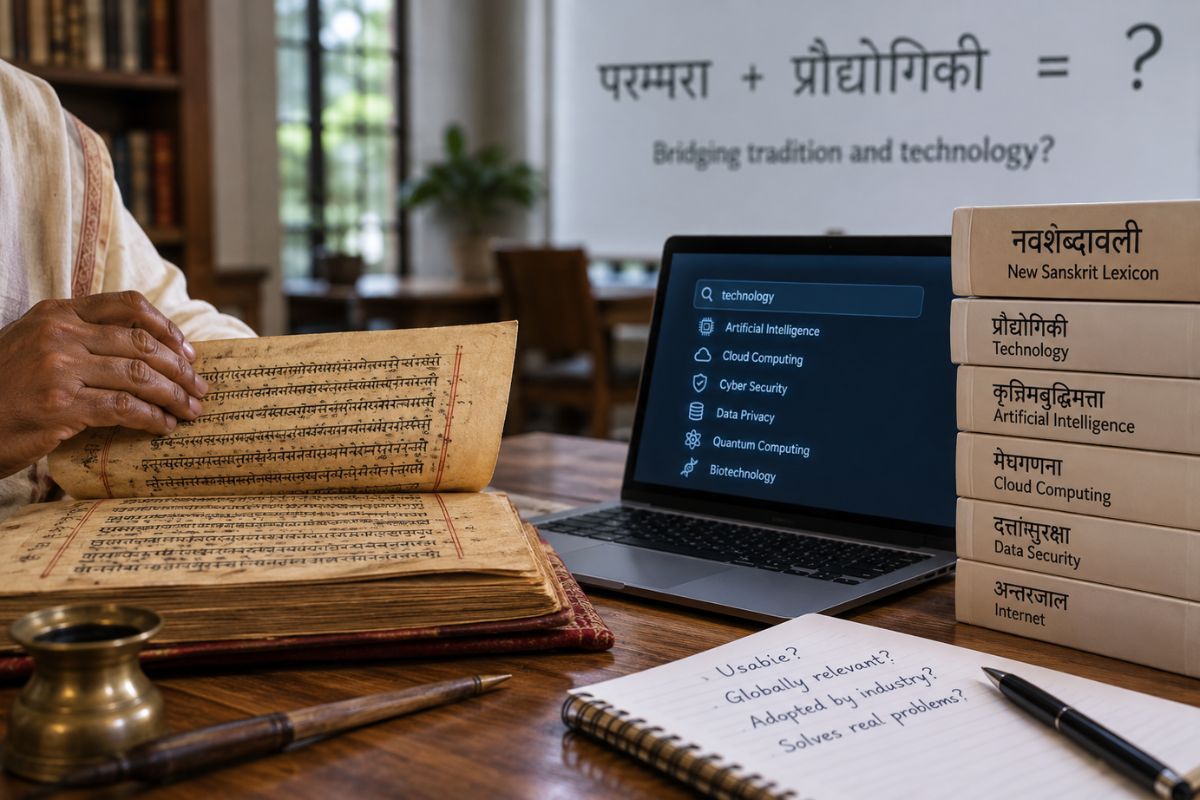
At Clarity Times, we examine what mainstream narratives omit. This dispatch investigates institutional incentives, policy fine print, and multi-dimensional community impacts.
Yes, the Indian government has funded Sanskrit technical glossaries for engineering and science since 1961, but classroom adoption remains near zero. Despite new academic projects reviving this top-down linguistic approach, decades of enrollment data and linguistic research show that students consistently reject classical translations in favor of English loanwords.
While new initiatives claim Sanskritized vocabulary increases accessibility, historical evidence proves these formal translations actually decrease comprehension for regional-medium students.
Why Did the 1961 Sanskrit Technical Glossaries Fail?
The 1961 glossaries failed because the state-sponsored translations were too complex for daily classroom use, leading to near-zero adoption among engineering students.
The Commission for Scientific and Technical Terminology (CSTT) – a government body created to build a unified scientific vocabulary – was established by the Ministry of Education on October 1, 1961. For more than six decades, the commission has actively published glossaries for disciplines ranging from civil engineering to botany.
These state-sponsored dictionaries rarely reach the students they target. Recent government efforts to push vernacular higher education reflect this historical disinterest. When the All India Council for Technical Education (AICTE) approved 1,230 seats for regional language engineering courses across 19 institutes, only 255 students enrolled, according to data reported by ThePrint.
The resulting translated texts sit in university reference libraries rather than on student desks.
Does the Telugu Computer Science Lexicon Offer a New Approach?
No, the new Telugu computer science lexicon replicates the exact linguistic framework the Indian government established in 1961, relying on classical Sanskrit roots rather than modern spoken vernacular.
This historical precedent is absent from the recent coverage of a new technical lexicon developed at Dartmouth College. Computer science professor Siddhartha Jayanti recently published a research paper in Telugu, inventing terms like asamakālikamu for “asynchronous.”
Jayanti built a typesetting workflow called TeluguTeX – a software tool designed to format regional scripts alongside mathematical notation. His vocabulary relies on modifying root words from Sanskrit with prefixes and suffixes to create compound words for modern computing concepts.
Defending the utility of his method, Jayanti argued that classical roots offer deeper comprehension. “When you can derive terms natively, they mean things to people,” Jayanti said in a Dartmouth press release. “They can relate them to other words; they can linguistically understand them, as well as in a scientific way.”
Why Do Regional STEM Students Prefer Code-Switching?
Regional STEM students prefer code-switching to English loanwords because classical translations increase their cognitive load, requiring them to decipher complex vocabulary before processing the actual science.
Academic studies in multilingual education consistently show that students actively switch to English loanwords during complex group discussions. According to a linguistic study on bilingual classrooms published on Scribd, code-switching bridges language gaps and eases cognitive processing.
A student studying the state syllabus in Malayalam might read a Sanskrit-derived term for a botanical process in their textbook, but they use the English equivalent when discussing it. English loanwords – already absorbed through mobile internet usage and daily conversation – bypass linguistic friction.
What Happens When Vernacular STEM Students Enter the Tech Workforce?
When vernacular-medium students enter the global software industry, they must discard their translated classical vocabulary and re-learn English syntax to write executable code.
The global tech industry operates strictly in English. Translating the foundational concepts of parallel computing into Telugu creates a secondary learning curve the moment a student opens an Integrated Development Environment (IDE) – the core software application programmers use to write and test code.
A student taught to conceptualize computer architecture using classical compound words cannot use that vocabulary to read compiler error logs.
How is the National Education Policy Funding Translation Today?
The National Education Policy (NEP) 2020 is directing millions of rupees toward new regional STEM textbooks using the exact classical translation models that students historically avoid.
The AICTE has already earmarked a budget of ₹18.6 crores specifically to translate technical engineering books into 12 Indian languages, according to Careers360. The Ministry of Education maintains that formal glossaries lay necessary groundwork for educational equity, even if immediate classroom adoption is low.
Funding continues to flow toward new translation contracts. Without integrating 60 years of behavioral data on how students actually speak and learn, the next generation of regional STEM textbooks risks suffering the same fate as the 1961 glossaries.
Frequently Asked Questions
Who creates the scientific vocabulary for Indian languages? Since 1961, the Commission for Scientific and Technical Terminology (CSTT) has created official technical glossaries for the Indian government. Recently, academic researchers have also started building independent lexicons using similar Sanskrit-based frameworks.
Are regional language engineering courses popular in India? No, historical enrollment data shows very low demand. For example, when the AICTE recently opened 1,230 seats for regional language engineering courses, only 255 students actually enrolled.
Why do students struggle with Sanskrit-based scientific terms? Sanskrit-based translations often increase a student’s cognitive load. Students must first decipher the complex, multi-syllabic classical word before they can begin to understand the underlying scientific concept it describes, which is why they usually default to familiar English loanwords.
Editorial Independence & Corrections
Clarity Times is published by Beeps Venture Technologies LLP under strict editorial independence charters. We uphold rigorous sourcing and verification protocols. Noticed a factual omission or error? Review our Correction Protocols or contact our editorial desk at mail@claritytimes.org.

Praseetha K
Investigative journalist and research analyst contributing independent field reports and structural analysis for Clarity Times.