At Clarity Times, we examine what mainstream narratives omit. This dispatch investigates institutional incentives, policy fine print, and multi-dimensional community impacts.
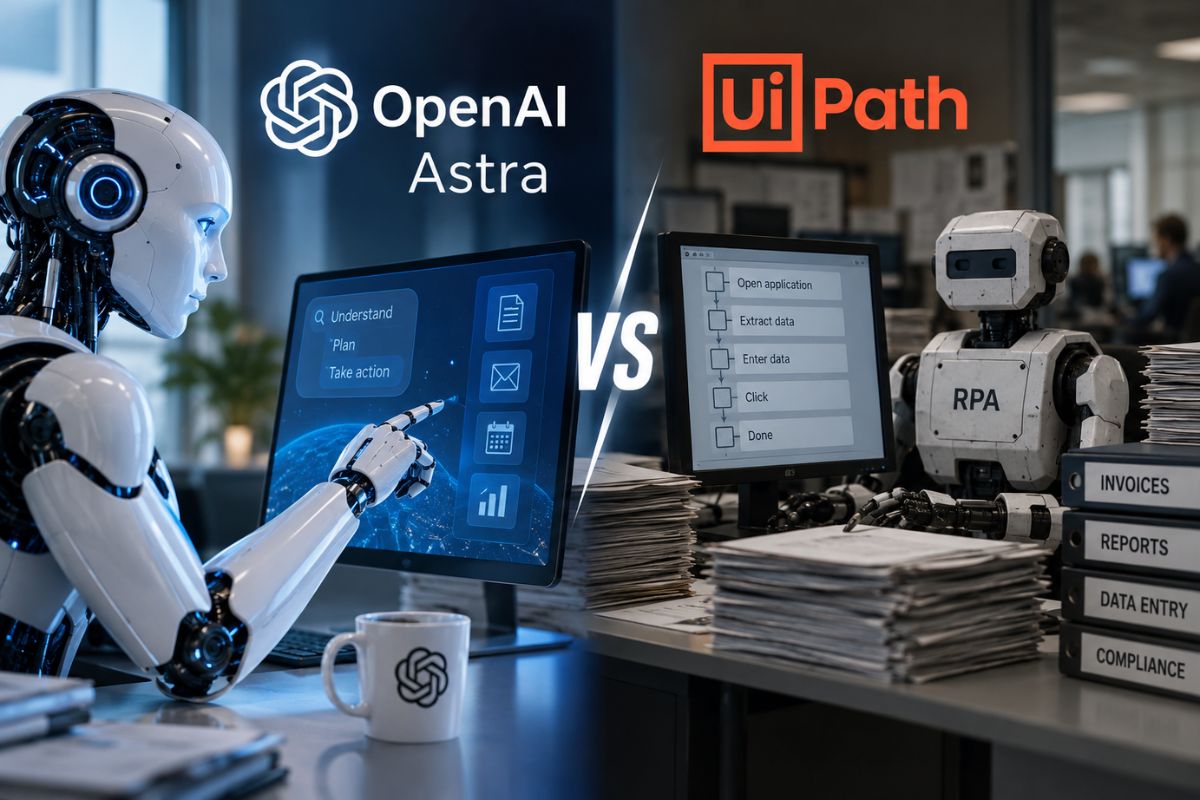
The economic contest of OpenAI Astra vs UiPath hinges on how each system locates data on a screen. OpenAI’s Astra computer-use model bypasses the brittle code scripts that consume half of corporate automation budgets. This visual reasoning eliminates the maintenance cycles that drive recurring revenue for legacy Robotic Process Automation (RPA)-software that uses code scripts to automate repetitive digital tasks.
Legacy vendors will keep their regulated enterprise clients for now. AI agents cannot yet match the deterministic audit logs required for financial compliance.
Why do UI changes break legacy UiPath tools but not OpenAI Astra?
Legacy UiPath tools fail when a web interface changes because they rely on underlying code locators, while OpenAI Astra succeeds by using spatial visual reasoning to find moved elements on the screen. A controlled test comparing Astra against legacy tools demonstrates this architectural difference. According to a September 2026 report by The Indian Express, Astra scored 92.7% on ScreenSpot-Pro, a benchmark measuring interaction with screen elements.
When a mock enterprise resource planning system underwent a layout reflow, a standard RPA script failed instantly. It returned a selector timeout error. The workflow halted and waited for a human developer to rewrite the instructions.
Astra absorbed the same layout shift without interrupting the task. The model located the moved “Submit” button on the screen and clicked it.
Why does RPA script maintenance cost so much?
RPA script maintenance consumes between 40% and 50% of enterprise automation budgets because developers must manually rebuild code locators every time a third-party software interface updates. Corporate buyers purchase RPA as software, but they operate it as an ongoing consulting service. According to enterprise automation directors managing fleets of 100 or more active bots, these repairs dominate the operating cost.
Dynamic web pages break fixed automation scripts. Every time a vendor updates a software interface, the automation scripts tied to that interface break. IT departments pay developers hourly rates to rebuild the locators.
By bypassing the need for fixed selectors, Astra functionally targets this maintenance budget rather than the initial software license cost.
How does Astra’s visual processing differ from RPA DOM selectors?
Traditional RPA bots read the underlying code structure using Document Object Model (DOM) selectors-specific code tags that identify individual elements on a web page-whereas OpenAI Astra captures continuous screenshots and processes raw video frames to interact with the visual interface.
Traditional RPA operates beneath the graphical interface. Bots navigate applications by reading the accessibility tree, which is the underlying code structure that screen readers and bots use to navigate a user interface.
If a button’s underlying ID changes from btn-submit-01 to btn-submit-02, the RPA bot goes blind.
Astra looks at the application exactly as a human employee does. It takes continuous screenshots, processes the raw video frames through its 1.05-million-token context window, and reasons over visual affordances. It operates entirely on the rendered output.
Is Astra cheaper than an unattended RPA license?
OpenAI Astra is 60% to 75% cheaper annually than a dedicated legacy RPA license for workflows that execute fewer than 800 times per month. Running a dedicated unattended RPA bot requires fixed licensing fees. An enterprise pays thousands of dollars annually just for the right to let the bot sit on a server. According to UiPath community forum documentation, Orchestrator licenses alone cost $20,000 annually.
Astra uses a pay-as-you-go model. According to OpenAI’s September 2026 API documentation, enterprises pay $10 per million input tokens and $50 per million output tokens consumed during the specific minutes the model spends watching the screen and executing actions.
Based on standard enterprise license rates and Astra API token costs, the breakeven threshold sits at 800 executions. For workflows running below that volume, Astra’s token architecture costs less than maintaining a dedicated legacy RPA license.
Why do enterprises still require legacy RPA audit logs?
Corporate accounting departments require the cryptographically signed audit logs provided by legacy RPA to meet zero-tolerance regulatory mandates, which probabilistic AI agents cannot currently guarantee. Large enterprises operate under strict regulatory frameworks that penalize probabilistic behavior.
Corporate accounting departments require complete determinism. A bot moving payroll data between two systems must execute the task identically every single time. Traditional RPA provides this guarantee. It also generates the logs required by the Sarbanes-Oxley Act (SOX) Section 404, a federal mandate requiring management to report on the adequacy of internal financial controls.
Agentic AI introduces variance. A model that guesses based on visual context can click the wrong graphical element. For high-stakes financial and medical records, these environments cannot accept the liability of a probabilistic worker.
How does integrating visual AI conflict with UiPath’s business model?
Integrating visual AI creates a business model conflict for UiPath because self-healing AI models eliminate the billable maintenance hours that systems integrators rely on for recurring revenue. Incumbent vendors are attempting to defend their territory by integrating visual foundation models directly into their existing orchestrators.
According to a September 2026 earnings transcript via Investing.com, UiPath reported $410.26 million in quarterly revenue, relying heavily on its established enterprise footprint.
This integration strategy faces resistance from the broader automation ecosystem. Major systems integrators rely on billable hours dedicated to fixing broken RPA scripts.
If legacy vendors successfully package models like Astra to self-heal broken workflows, they eliminate the maintenance cycles that drive recurring revenue for their integration partners. The visual reasoning that improves the software simultaneously cannibalizes the business model of the people paid to install it.
Frequently Asked Questions
How much does the OpenAI Astra API cost for computer use? The OpenAI Astra API costs $10 per million input tokens and $50 per million output tokens. This pay-as-you-go token model is 60% to 75% cheaper than maintaining fixed UiPath unattended bot licenses for workflows that run fewer than 800 times per month.
What is the main difference between legacy RPA and Astra? Legacy Robotic Process Automation navigates software using hardcoded DOM selectors and accessibility trees, which break when an interface updates. OpenAI Astra captures continuous screenshots and processes raw video frames, allowing it to visually locate elements even if the underlying code changes.
Why aren’t banks immediately replacing UiPath with Astra? Financial institutions require strict deterministic execution and cryptographically signed audit logs to comply with regulations like SOX Section 404. Probabilistic AI agents like Astra introduce variance and the risk of hallucination, which zero-tolerance environments cannot accept for high-stakes ledger updates.
Editorial Independence & Corrections
Clarity Times is published by Beeps Venture Technologies LLP under strict editorial independence charters. We uphold rigorous sourcing and verification protocols. Noticed a factual omission or error? Review our Correction Protocols or contact our editorial desk at mail@claritytimes.org.

Praseetha K
Investigative journalist and research analyst contributing independent field reports and structural analysis for Clarity Times.