At Clarity Times, we examine what mainstream narratives omit. This dispatch investigates institutional incentives, policy fine print, and multi-dimensional community impacts.
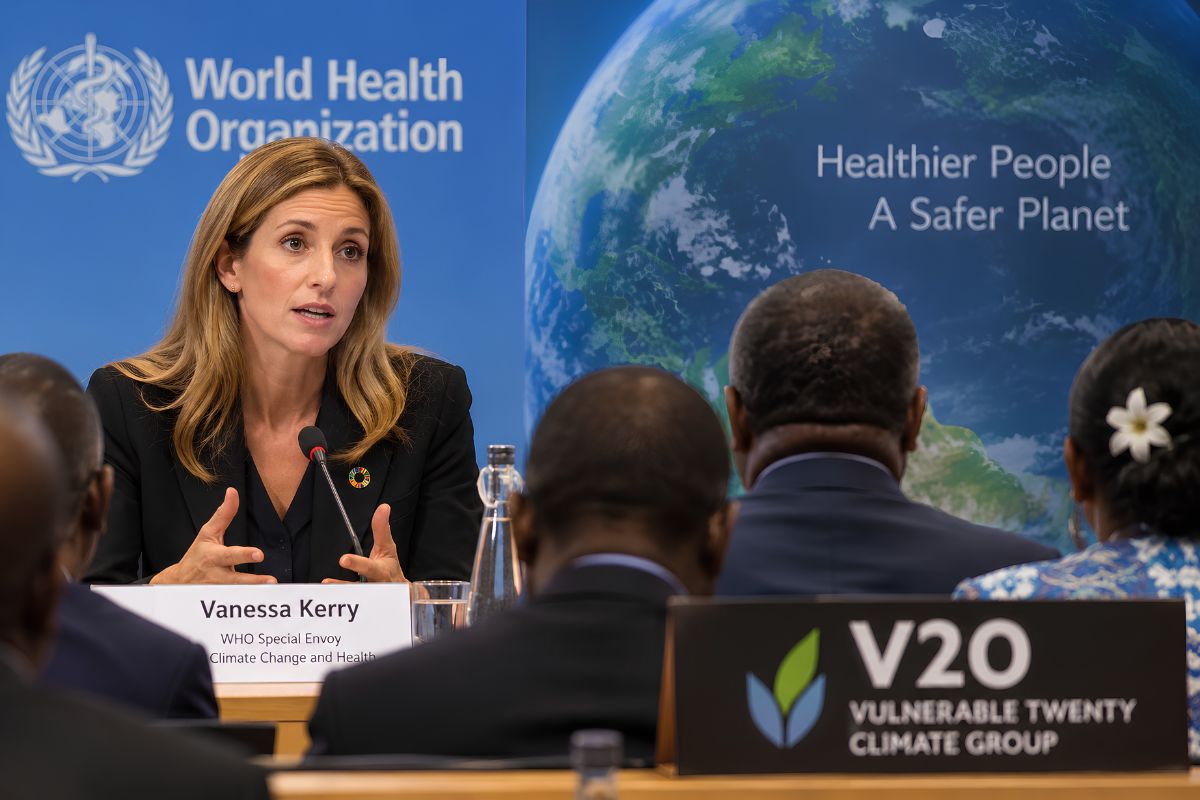
How do climate-vulnerable countries view the appointment of Vanessa Kerry as the WHO climate envoy? Financial delegates from the V20 group of climate-vulnerable nations consider the position an institutional detour. They contend that the envoy’s mandate relies primarily on voluntary philanthropic fundraising, which diverts critical political attention away from their core demand: direct, non-debt fiscal transfers necessary to rebuild climate-devastated healthcare infrastructure.
The central contradiction is undeniable: the World Health Organization designed the envoy role to mobilize voluntary capital from Western donors, whereas climate-vulnerable governments are formally demanding statutory, non-repayable compensation directed immediately into their sovereign treasuries.
Why do V20 delegates view the Vanessa Kerry WHO climate envoy role as a diplomatic detour?
V20 health delegates perceive the envoy model as a diversion because it attempts to address a structural sovereign debt crisis through the appointment of a prominent American political figure, rather than through systemic reform of international finance. In their 16th Ministerial Communiqué, V20 finance ministers explicitly declared that the “international advisory ecosystems” favored by Western institutions prioritize bureaucratic processes over tangible, life-saving outcomes.
This frustration does not indicate a categorical rejection of international aid by vulnerable countries. In fact, multiple regional health ministries maintain active partnerships with Seed Global Health, the medical non-profit organization directed by Dr. Kerry.
The conflict centers strictly on sovereign fiscal policy. Vulnerable nations demand autonomous control over their climate recovery budgets, rejecting the imposition of an intermediary advocating on their behalf.
| Financing Model | Funding Source | Primary Beneficiaries |
|---|---|---|
| Special Envoy Model | Voluntary philanthropic donations | Western NGOs and global consultancies |
| V20 Structural Demand | Statutory loss & damage funds | National treasuries and local health systems |
How does philanthropic pledging differ from sovereign loss and damage?
Philanthropic pledging depends on the voluntary largesse of private donors, whereas loss and damage health funding functions as statutory, non-repayable compensation mandated from historic emitters to reconstruct destroyed infrastructure. This structural misalignment defines the chasm between the envoy’s portfolio and the formal, binding objectives of the Global South.
The WHO’s official Terms of Reference task Dr. Kerry with amplifying messaging, forging public-private partnerships, and mobilizing voluntary donor capital.
In stark contrast, the V20—a coalition of 74 nations advocating for systemic global financial reform—pursues a fundamentally different legal framework. Under the Accra-to-Marrakech agenda, vulnerable economies demand an international financial architecture that deposits compensation directly into national treasuries. They insist that funds intended to replace flooded clinics be delivered entirely outside the bureaucratic and fragmented philanthropic grant system.
Do high-profile WHO envoys increase permanent health budgets?
Historically, prominent WHO envoys successfully generate media visibility and intermittent private pledges; however, they consistently fail to expand the statutory, assessed budget commitments of member states. The World Health Organization repeatedly leverages prominent Western figures to stimulate institutional awareness.
For instance, during Michael Bloomberg’s tenure as a UN Special Envoy for noncommunicable diseases, his appointment facilitated multi-million-dollar voluntary stop-gaps—funded primarily by his own philanthropic organization—to bridge funding shortfalls from the United States.
Such appointments seldom enlarge the permanent fiscal space available to developing economies. Dr. Tedros Adhanom Ghebreyesus, the WHO Director-General, appointed Dr. Kerry to elevate global awareness regarding climate-driven health threats, yet her portfolio inherently lacks executive budgetary authority.
How much climate-health capital is absorbed by Western intermediaries?
Data compiled by the World Economic Forum reveals a troubling reality: less than 20% of global climate finance directly reaches frontline communities, with the vast majority consumed by intermediary layers. This economic extraction is precisely the penalty V20 finance officials are determined to eliminate.
Furthermore, tracking by the Organisation for Economic Co-operation and Development (OECD) demonstrates that the remaining 80% of funds is largely absorbed by international non-governmental organizations, bilateral consultancies, and significant administrative overhead. This intermediary ecosystem extracts immense value long before capital ever reaches a district hospital in Bangladesh or Ghana.
The most compelling institutional defense of the WHO envoy strategy relies on its capacity to access Western capital. The WHO officially designates Special Envoys as advisory accelerators designed to galvanize global support, rather than as executives dictating policy.
Dr. Kerry has correctly observed that decades of structural readjustment policies have decimated domestic health budgets across the Global South. An American envoy possessing direct access to United States congressional leaders and major philanthropic foundations can theoretically unlock capital pools that technical delegates from small island states are structurally blocked from accessing.
What alternative financial reforms are V20 ministers demanding?
V20 leaders are issuing formal demands for direct access windows within multilateral climate funds and the immediate implementation of Climate Resilient Debt Clauses (CRDCs) to liberate domestic capital during crises. CRDCs operate as essential legal mechanisms that automatically suspend a country’s sovereign debt obligations in the event of a severe climate disaster.
If a catastrophic hurricane decimates a member state’s healthcare network, a CRDC ensures immediate domestic liquidity for emergency response, circumventing the need for protracted new loan negotiations.
Direct access windows would enable health ministries to secure adaptation financing directly, bypassing Western implementing agencies entirely. To date, Geneva has largely deferred action on these structural mechanisms, leaving the WHO special envoy mandate as its most visible, yet limited, policy response to health resilience.
Frequently Asked Questions
What is the role of the WHO Special Envoy for Climate Change and Health?
The WHO Special Envoy for Climate Change and Health is an advisory position designed to amplify climate-health messaging, forge public-private partnerships, and mobilize voluntary donor capital. Dr. Vanessa Kerry currently holds this role, which lacks executive budgetary authority over member states.
What is the V20 and what do they advocate for?
The Vulnerable Twenty (V20) Group is a bloc of 74 climate-vulnerable nations advocating for systemic global financial reforms. They demand direct, non-repayable loss and damage funding to rebuild infrastructure destroyed by climate change, rather than relying on philanthropic grants from Western intermediaries.
Why do climate-vulnerable countries oppose the philanthropic health funding model?
V20 nations oppose the philanthropic model because voluntary pledges are heavily absorbed by international intermediaries before reaching the ground. According to the World Economic Forum, less than 20% of global climate finance reaches local levels, with the rest consumed by administrative overhead and Western consultancies.
Editorial Independence & Corrections
Clarity Times is published by Beeps Venture Technologies LLP under strict editorial independence charters. We uphold rigorous sourcing and verification protocols. Noticed a factual omission or error? Review our Correction Protocols or contact our editorial desk at mail@claritytimes.org.

Praseetha K
Investigative journalist and research analyst contributing independent field reports and structural analysis for Clarity Times.