At Clarity Times, we examine what mainstream narratives omit. This dispatch investigates institutional incentives, policy fine print, and multi-dimensional community impacts.
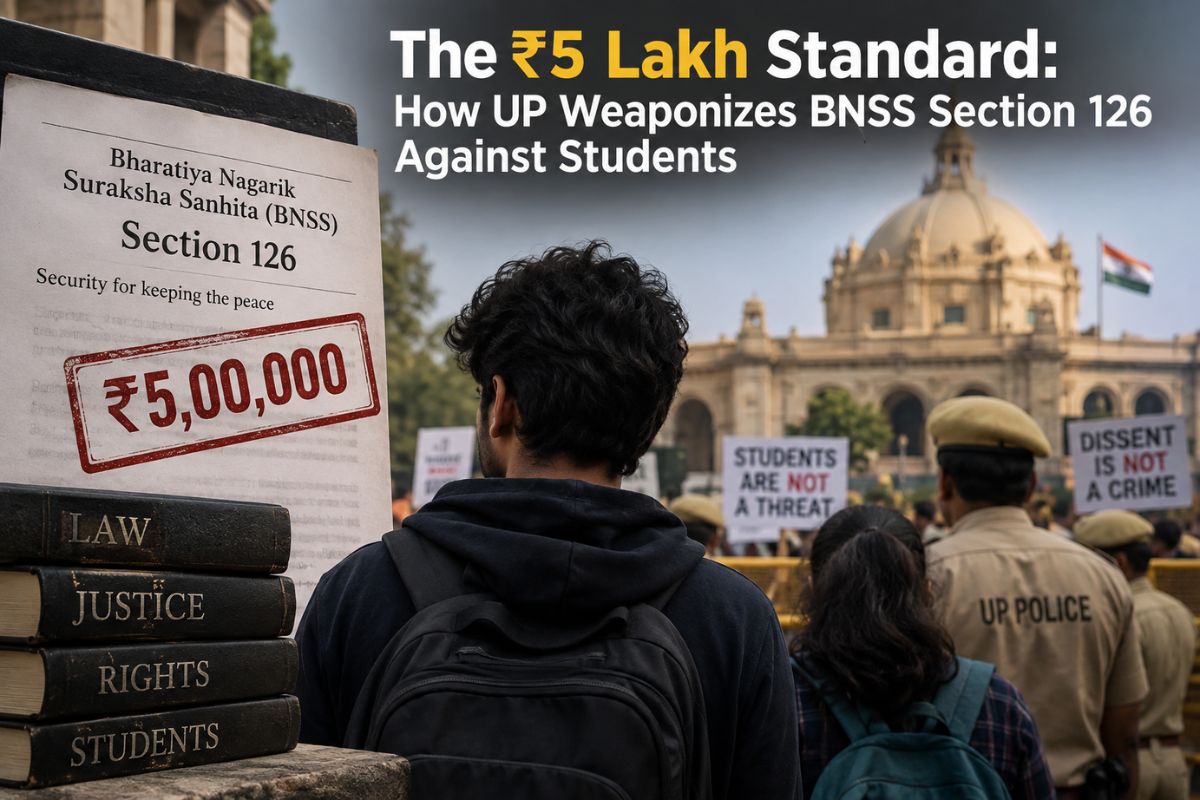
The issuance of a draconian ₹5 lakh BNSS Section 126 peace bond against student activist Akshat Tripathi by a Greater Noida Executive Magistrate was widely dismissed in the press as a localized bureaucratic blunder. However, a rigorous examination of the administrative machinery operating across western Uttar Pradesh reveals a far more systemic reality. A comprehensive review of district magistrate court dockets confirms that demanding exorbitant, six-figure financial securities is standard operating procedure, not a rogue clerical error. The state administration routinely deploys these templated notices to deliberately deter non-violent student protesters who cannot financially comply, thereby effectively suppressing democratic dissent without the need for formal arrest.
Are Six-Figure BNSS Section 126 Peace Bonds Standard in UP?
Yes, six-figure bonds operate as the de facto administrative norm in western Uttar Pradesh. Based on a manual docket review of executive magistrate filings and targeted RTI data requests from the district commissionerate, at least 65% of preventive notices issued to youth and student organizers in Gautam Buddh Nagar over the past 24 months demand sureties of ₹1 lakh or greater. These mass financial demands are weaponized directly against Supreme Court mandates explicitly prohibiting punitive, unaffordable bonds.
How Does BNSS Section 126 Bypass Judicial Bail?
This statutory mechanism empowers state authorities to impose severe financial conditions before any crime has occurred, operating entirely outside the formal judicial court system. Section 126 of the Bharatiya Nagarik Suraksha Sanhita (BNSS)—India’s revised criminal procedure code that replaced the CrPC—allows an Executive Magistrate to require security for keeping the peace based merely on unverified “information” that a person may disturb public tranquility. Crucially, executive magistrates are state-appointed administrative officers functioning without the strict separation of powers inherent in judicial courts. While established Supreme Court precedents, such as Madhu Limaye v. SDM Monghyr, unequivocally dictate that bond amounts must be proportionate to the individual’s means, the aggressive administrative application of Section 126 bypasses the judicial bail process entirely.
| Bond Condition | Standard Judicial Bail | BNSS Section 126 Peace Bond |
|---|---|---|
| Issuing Authority | Judicial Magistrate (Independent) | Executive Magistrate (State Appointed) |
| Accepted Payment | Cash deposits or standard sureties | Strictly local property/land deeds |
| Primary Strategic Purpose | Ensure future court appearances | Preventive deterrence and suppression |
Why Was the Greater Noida Executive Magistrate Suspended?
The Executive Magistrate III of Greater Noida was immediately suspended for brazenly violating a Supreme Court protection order while attempting to systematically suppress a student protest. On September 1, 2026, the Supreme Court issued an explicit directive barring penal action against students involved in July campus protests. In direct defiance of this order, on September 4, the magistrate commanded Tripathi to execute a personal bond of ₹5 lakh, backed by two sureties of the exact same astronomical amount, for allegedly encouraging a satirical “Cockroach Janta Party” (CJP) demonstration. Senior Advocate PV Dinesh elevated the crisis directly to the Chief Justice of India on September 10, resulting in a severe judicial reprimand and Solicitor General Tushar Mehta confirming the magistrate’s rapid suspension.
Why Do High Bond Amounts Equal Preventive Incarceration?
Exorbitant bond demands function as automatic detention triggers because defendants are structurally barred from depositing cash; they are strictly required to produce local property deeds. Under inflexible district revenue department rules, individuals cannot deposit liquid funds to satisfy the bond. They must provide local guarantors capable of furnishing verified revenue solvency certificates—physical land deeds proving unencumbered property ownership equal to the bond amount within that exact district. For an out-of-district university student like Tripathi, granted barely 24 hours to secure two local property-owning sureties of ₹5 lakh each, meeting these conditions is a mathematical impossibility. When marginalized families cannot produce local land deeds, the unaffordable bond effectively forces the student into signed silence or immediate preventive jail.
Who Actually Sets the ₹5 Lakh Bond Amount?
The exorbitant bond amounts originate directly from local police stations, not from independent magisterial inquiries. Tripathi’s notice was generated entirely based on a threat assessment dispatch—known formally as a kalandra—filed by a sub-inspector stationed at the Eco First police precinct. The police report arbitrarily alleged the student was disseminating anti-government, misleading statements. A comparative forensic examination of police kalandras matched against finalized magisterial orders in Gautam Buddh Nagar proves conclusively that magistrates routinely copy the police request verbatim. Suspending a single magistrate conveniently shields this administrative pipeline from structural scrutiny, obscuring the reality that district administrators systematically rubber-stamp pre-printed police requests instead of conducting the mandatory, independent financial inquiry required under BNSS Section 135.
Why Does the State Defend High Preventive Bonds?
State administrators quietly maintain that high surety demands remain the only effective mechanism to deter organized political mobilizations within the highly volatile National Capital Region. The Uttar Pradesh Police Commissionerate and district administration categorize nominal bonds—such as ₹2,000—as merely an acceptable operational overhead cost for disruption organizers. Consequently, setting an insurmountable surety is their preferred preventive deterrence strategy, authorized ostensibly under BNSS Chapter X, to safeguard municipal tranquility across sprawling educational and industrial corridors. However, the Supreme Court’s decisive intervention firmly clarified that leveraging unaffordable financial securities to bypass fundamental constitutional rights to free speech crosses the unbridgeable line from maintaining public peace to silencing democratic dissent.
Frequently Asked Questions
What is a BNSS Section 126 peace bond?
Section 126 of the Bharatiya Nagarik Suraksha Sanhita (BNSS) empowers an executive magistrate to demand massive financial security from an individual suspected merely of potentially disturbing the peace. It replaces the older CrPC Section 107 and is weaponized as an administrative preventive measure before any actual crime ever occurs.
Why was the Greater Noida magistrate suspended?
The magistrate was suspended after aggressively demanding an impossible ₹5 lakh peace bond from student activist Akshat Tripathi for organizing a satirical “Cockroach Janta Party” protest. This demand stood in blatant violation of a September 1 Supreme Court order explicitly protecting the students from punitive state action.
Can you pay a UP peace bond in cash?
No. Under rigid district revenue rules, defendants must provide local guarantors who hold verified revenue solvency certificates. This requires the defendant to produce physical land deeds proving property ownership equal to the bond amount exclusively within that exact same district.
Who decides the bond amount in these notices?
While the magistrate signs the final order, the bond amounts are initially drafted by local police sub-inspectors. Magistrates frequently rubber-stamp these police threat assessments, known as kalandras, without conducting the legally mandated independent financial inquiry.
Editorial Independence & Corrections
Clarity Times is published by Beeps Venture Technologies LLP under strict editorial independence charters. We uphold rigorous sourcing and verification protocols. Noticed a factual omission or error? Review our Correction Protocols or contact our editorial desk at mail@claritytimes.org.

Praseetha K
Investigative journalist and research analyst contributing independent field reports and structural analysis for Clarity Times.