At Clarity Times, we examine what mainstream narratives omit. This dispatch investigates institutional incentives, policy fine print, and multi-dimensional community impacts.
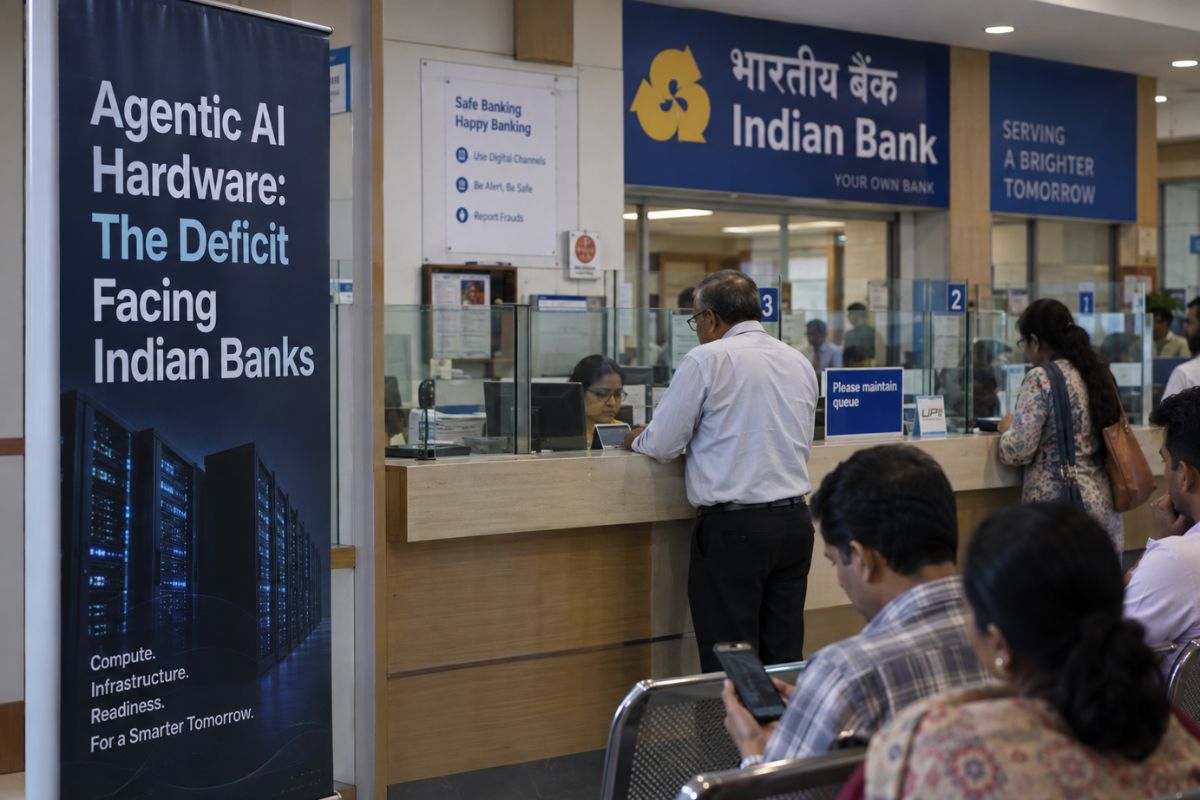
Indian public sector banks systematically lack the highly specialized Agentic AI hardware required to power complex autonomous models. To successfully deploy the advanced systems continuously championed by the central government, legacy financial institutions require a monumental leap in graphics processing infrastructure. This critical deficit actively forces public banks into a heavy, expensive reliance on US-based cloud monopolies, directly contradicting the prevailing national narrative of domestic technological sovereignty.
What are the Agentic AI hardware requirements for banks?
Deploying autonomous agents requires massive, interconnected clusters of high-end graphics processing units, rendering the standard centralized processors currently anchoring bank server rooms entirely obsolete. Graphics processing units (GPUs) are specialized electronic circuits engineered to rapidly manipulate memory for simultaneous parallel processing, the foundational requirement for generative AI.
Crucially, Agentic AI functions entirely differently from standard predictive algorithms or basic chatbots. Agentic AI refers to sophisticated artificial intelligence systems that execute continuous, autonomous loops to analyze unstructured data, formulate multi-step decisions, and execute complex tasks without requiring constant human prompting. Running a secure, enterprise-grade 70-billion-parameter autonomous model physically requires hundreds of interconnected GPUs operating in tandem.
Indian bank data centers are fundamentally built around central processing units (CPUs). These primary processors are designed exclusively to handle sequential, linear tasks, such as clearing straightforward ledger transactions or verifying cryptographic passwords. CPUs are physically incapable of handling the sheer volume of simultaneous parallel processing demanded by generative AI. Without initiating a total, ground-up hardware replacement, on-premises autonomous agents simply cannot function.
| Hardware Element | Traditional Banking Setup | Agentic AI Requirement |
|---|---|---|
| Core Processor | CPUs (Central Processing Units) | GPUs (Graphics Processing Units) |
| Processing Type | Sequential transaction processing | Massive parallel computation |
| Financial Model | Fixed capital expenditure (CapEx) | Recurring operational tokens (OpEx) |
| Infrastructure Control | On-premises bank data centers | Heavy reliance on foreign cloud hyperscalers |
Why are Indian banks outsourcing AI infrastructure to foreign hyperscalers?
To circumvent their crippling internal hardware deficit, public banks are forced to rent massive compute power directly from foreign hyperscalers. Hyperscalers are mammoth cloud service providers, such as Amazon Web Services (AWS) or Microsoft Azure, that command the capital to offer enterprise-scale computing resources on demand. This structural shift aggressively moves the foundation of India’s future financial technology away from domestic, sovereign data centers.
Top public sector banks have already initiated the migration of their complex workloads to foreign infrastructure. According to official government contract disclosures, the State Bank of India explicitly procures Microsoft Azure Public Cloud Services for its internal IT operations, cementing a clear operational reliance on US-based cloud providers.
This escalating dependency severely complicates the Indian government’s loudly stated goal of achieving total technological sovereignty. It forces risk-averse banks to precarious balance the Reserve Bank of India’s draconian data localization mandates against a fundamental lack of local computing power. According to industry assessments, only foreign hyperscalers currently possess the immediate, hyper-scaled hardware required to offer enterprise generative AI on demand.
What do procurement records reveal about bank GPU readiness?
Public sector IT procurement records unequivocally demonstrate that bank budgets remain rigidly focused on maintaining traditional, legacy setups, entirely devoid of the massive capital outlays required for independent GPU clusters. A forensic review of annualized bank spending confirms institutions are simply not acquiring the necessary hardware.
According to a comprehensive 2024 analysis published in the Journal of Emerging Technologies and Innovative Research, institutions heavily direct their finite IT funds into patching and upgrading centralized, CPU-based Core Banking Solutions (CBS) like Infosys Finacle and TCS BaNCS. Banks are emphatically not bulk-purchasing independent GPU clusters.
These procurement records signal that bank IT departments are prioritizing the survival of their existing core banking software rather than preparing for an impending, capital-intensive AI overhaul.
How does data localization conflict with cloud AI models?
Offloading banking operations to cloud-based AI models immediately triggers severe regulatory friction, primarily because the Reserve Bank of India mandates that sovereign financial data absolutely cannot leave the physical jurisdiction of the country for processing. Prime Minister Narendra Modi recently declared that advanced technologies like Agentic AI and quantum computing unlock transformative possibilities for the financial sector—a sentiment dutifully echoed by public bank executives.
The state government counters that direct hardware ownership by individual banks is redundant. According to the Ministry of Electronics and Information Technology, the state has actively subsidized a common computing facility housing over 38,000 GPUs under the ambitious IndiaAI Mission. Furthermore, IT officials note that domestic data centers, such as Yotta Data Services, are aggressively scaling up to provide sovereign AI resources locally in order to strictly satisfy the localization mandate.
What is the true cost of running AI inference for banking?
While cloud computing effectively patches the immediate physical hardware gap, it simultaneously introduces a devastating new financial paradigm by charging banks per individual data query rather than relying on a flat, depreciable server cost. Deploying autonomous agents means paying perpetually for continuous inference.
Operating an enterprise cloud model charges financial institutions by the exact volume of data processed. According to public Microsoft Azure pricing tiers, the platform commands roughly $2.68 per one million input tokens to execute the Meta Llama 3 70B enterprise AI model. For a mid-sized Indian bank tasked with processing millions of customer inquiries and automated transactions daily, this aggressive token-based pricing structure converts a manageable fixed infrastructure cost into a massive, endlessly recurring operational hemorrhage.
This ongoing inference expense represents an insurmountable barrier for institutions already struggling to secure funding for basic cybersecurity upgrades. The AI transition requires a permanent, highly disruptive shift in how public banks structure and deploy their IT budgets.
Frequently Asked Questions (FAQ)
Can Indian banks run Agentic AI on their current servers?
No, Indian banks cannot run Agentic AI on their current hardware. Bank data centers operate exclusively on CPUs designed for sequential transactions, whereas autonomous AI fundamentally requires massive clusters of specialized GPUs for parallel processing.
Where will Indian banks get the hardware for AI?
Instead of purchasing their own localized hardware, Indian banks are renting compute power from dominant foreign cloud hyperscalers like Microsoft Azure and Amazon Web Services. For example, the State Bank of India already procures Microsoft Azure services for its critical IT operations.
Does using foreign cloud providers violate India’s data rules?
The Reserve Bank of India strictly requires sovereign financial data to remain physically within the country. Banks must therefore mathematically ensure that any foreign hyperscaler they contract processes the AI data entirely within India-based data centers to remain compliant with strict data localization laws.
How much does it cost a bank to run Agentic AI?
Running Agentic AI permanently shifts costs from flat server capital expenditures to pay-per-query operational billing. Providers like Microsoft Azure charge roughly $2.68 per one million input tokens, creating a massive, perpetually recurring operational expense for banks executing millions of daily autonomous transactions.
Editorial Independence & Corrections
Clarity Times is published by Beeps Venture Technologies LLP under strict editorial independence charters. We uphold rigorous sourcing and verification protocols. Noticed a factual omission or error? Review our Correction Protocols or contact our editorial desk at mail@claritytimes.org.

Praseetha K
Investigative journalist and research analyst contributing independent field reports and structural analysis for Clarity Times.