Telangana Chief Minister A. Revanth Reddy is urging farmers to skip winter Telangana Yasangi paddy, citing El Niño water shortages, because every 10 lakh acres left unplanted saves the state treasury ₹1,800 crore to ₹2,200 crore in free summer borewell electricity and ₹500-per-quintal fine-paddy bonuses as ₹28,486 crore in utility arrears come due.
How Much Does Telangana Yasangi Paddy Cost the State Per Acre?
Every 1 lakh acres of Telangana Yasangi paddy left fallow reduces state financial obligations by ₹180 crore to ₹220 crore, according to Clarity Times calculations based on Telangana Electricity Regulatory Commission (TGERC) tariff filings and state procurement rules. Across a 10-lakh-acre reduction, the state exchequer avoids ₹1,800 crore to ₹2,200 crore in combined cash outlays between February and June.
Yasangi is Telangana’s winter-to-summer agricultural season running from November through May. Unlike the monsoon crop, winter paddy relies almost entirely on electric borewells pumping groundwater under the state’s free, unmetered farm electricity subsidy.
That per-acre saving comes from two state budget lines:
- The ₹500 paddy bonus Telangana payout: Under the Civil Supplies Department procurement policy reported by The New Indian Express, the state pays a ₹500-per-quintal (₹5,000-per-metric-tonne) bonus above the central Minimum Support Price across 8,283 purchase centers on seven notified fine paddy varieties: BPT 5204, RNR 15048, HMT Sona, Jai Sriram, KNM 1638, WGL 44, and KNM 7715. To limit cash payouts before harvest, the Telangana Agriculture Department tightened seed-bill and land-passbook verification rules for the ₹500 bonus after fine-variety sowing reached 2.51 lakh acres in Kamareddy district alone. At Telangana’s average Yasangi yield of 22 to 25 quintals per acre, the bonus costs the state treasury ₹11,000 to ₹12,500 per acre, or ₹110 crore to ₹125 crore for every 1 lakh acres harvested and sold to state centers.
- The Telangana free farm electricity subsidy: On March 30, 2026, the state regulator released the TGERC Retail Supply Tariff Order for FY 2026–27, approving more than ₹15,000 crore in state power subsidies to cover free agricultural supply. Drawing water for a 120-day summer paddy crop through a standard 5-horsepower borewell pump requires utilities to buy short-term electricity on the Indian Energy Exchange (IEX), India’s automated national spot market for daily electricity trading, during the peak summer months of March through May, adding ₹7,000 to ₹9,500 per acre in power purchase costs.
Every acre of paddy a farmer leaves unsown in November removes both liabilities from the state budget before summer begins.
Why Is TGRPDCL Launching With ₹28,486 Crore in Unpaid State Dues?
The Telangana Rythu Power Distribution Company Ltd. (TGRPDCL) is launching in November 2026 with ₹28,486 crore in unpaid state government subsidy arrears and only ₹5 crore in paid-up equity, according to TGERC Distribution Licence Petition O.P. No. 11 of 2026. TGRPDCL is a dedicated state agricultural power distribution company (DISCOM) licensed by TGERC on July 12, 2026, to manage rural electricity supply, as documented in Vyqon’s regulatory analysis of the November 2026 TGRPDCL launch.
Created under Telangana Energy Department Government Order (G.O.) Ms. No. 44 on December 17, 2025, and G.O. Ms. No. 4 on March 11, 2026, the TGRPDCL agricultural power utility separates subsidized farm and water-supply loads from the state’s two existing commercial utilities: the Southern Power Distribution Company of Telangana Ltd. (TGSPDCL) and the Northern Power Distribution Company of Telangana Ltd. (TGNPDCL).
Regulatory records in TGERC Petition O.P. No. 11 of 2026, filed on April 6, 2026, detail the utility’s starting balance sheet:
- Consumer base: 30 lakh agricultural borewell connections, lift irrigation schemes, and Mission Bhagiratha water grids, representing 42% of Telangana’s total electricity consumption (up from zero dedicated rural utilities prior to November 2026).
- Paid-up equity capital: ₹5 crore against ₹4,929 crore in book-value transferred assets.
- Inherited state arrears: ₹28,486 crore in unpaid government subsidy receivables, accounting for 79% of the ₹35,983 crore in total government dues transferred from TGSPDCL and TGNPDCL.
- Generator and working-capital debt: ₹26,950 crore in unpaid dues owed to state power generation companies (GENCOs) alongside a ₹9,032 crore working-capital debt load.
- Annual subsidy requirement: ₹8,000 crore from the state budget to cover ongoing free farm supply, while short-term bank financing for daily operations is recorded in the filing as “yet to be tied up.”
Five crore rupees in equity against ₹28,486 crore in unpaid state bills.
During the regulator’s public hearing on May 29, 2026, the Federation of Telangana Chambers of Commerce and Industry (FTCCI) filed objections regarding the financial viability of operating an under-capitalized utility without committed working capital. In regulatory filings dated April 25, May 5, and May 18, 2026, cited in The Siasat Daily’s review of the TGERC licensing proceedings, power-sector analyst M. Venugopala Rao stated that the liquidity crisis facing Telangana’s utilities comes from unpaid government electricity bills and subsidy arrears rather than corporate structure.
TGERC filings also show that a ₹1,306 crore procurement contract to install smart meters on 5.22 lakh agricultural distribution transformers remained untendered at the time of licensing, leaving TGRPDCL to enter the November sowing season without automated load meters or approved bank credit lines.
What Did the Revanth Reddy El Niño Drought Clash Leave Out?
The October 2026 political dispute over the Revanth Reddy El Niño drought warning centered on weather forecasts while omitting utility debt and procurement arrears. On October 20, 2026, the state government formed a Cabinet sub-committee chaired by Deputy Chief Minister Mallu Bhatti Vikramarka and Irrigation and Civil Supplies Minister N. Uttam Kumar Reddy to monitor El Niño, a periodic warming of the central and eastern tropical Pacific Ocean that shifts global rainfall patterns.
On October 23, Chief Minister A. Revanth Reddy stated that water and power shortages would run from October 2026 through July 2027, appointing Government Advisor and former Special Chief Secretary K. Ramakrishna Rao as Nodal Officer on El Niño to counter opposition claims, and announcing a post-Sankranti rural employment scheme starting in January 2027.
Leaders of the opposition Bharat Rashtra Samithi (BRS) rejected the weather explanation. BRS spokesperson Ravula Sridhar said on October 24 that the Chief Minister is scaring citizens and prioritizing party politics, while former minister T. Harish Rao demanded a state white paper on the drought, arguing that neighboring Andhra Pradesh faced no comparable emergency.
Meteorological records from the India Meteorological Department (IMD) Hyderabad center show an acute post-monsoon dry spell rather than a season-wide monsoon failure. According to The Times of India’s October 22 rainfall data report and The Siasat Daily’s district monsoon bulletin, Telangana recorded 3.5 mm of rainfall between October 1 and October 21, 2026, down 95% from the normal average of 75.6 mm, leaving 12 of 33 districts with zero rain ahead of winter sowing.
How Did Record 2025–26 Paddy Acreage Strain Civil Supplies Credit?
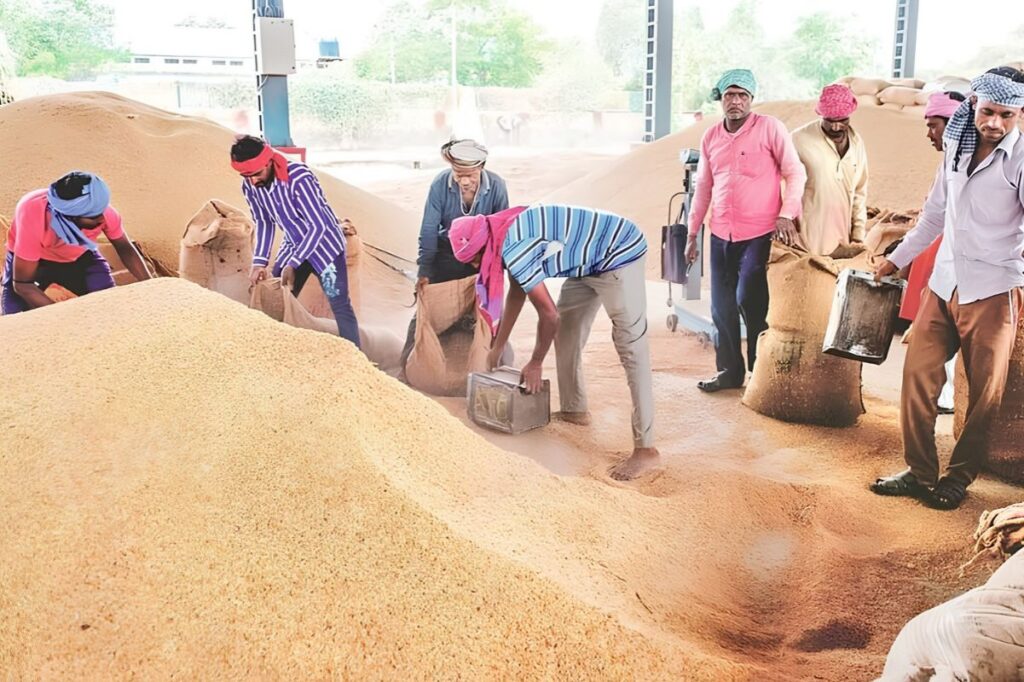
Telangana farmers planted a national-record 59.90 lakh acres of Rabi paddy in the 2025–26 season, driving state procurement to 75 lakh metric tonnes and leaving the state budget to fund unreimbursed ₹500-per-quintal bonuses above central grain quotas. According to a Telangana State Planning Department report cited by ETV Bharat’s June 2026 agricultural survey, Telangana’s 59.90 lakh acres accounted for more than 50% of India’s total Rabi paddy area, exceeding Tamil Nadu’s 30.76 lakh acres and Andhra Pradesh’s 17.29 lakh acres combined.
That harvest pushed state grain purchasing to an all-time high. As reported by The Hindu on June 9, 2026, the Telangana State Civil Supplies Corporation Ltd. (TGCSCL), the state agency that buys paddy from farmers at support prices, procured 75 lakh metric tonnes in the 2025–26 Rabi season, lifting full-year 2025–26 procurement to 147 lakh metric tonnes (up from 70.82 lakh tonnes in the Kharif season).
The state bought that volume even after the Union government cut its central intake quota, a gap documented in The New Indian Express report on Telangana exceeding central procurement targets by 21.3 lakh tonnes (procuring 75 lakh tonnes against an initial central target of 53.7 lakh tonnes). Under India’s decentralized procurement system, the central Food Corporation of India (FCI) reimburses state agencies for custom-milled rice, paddy that state-contracted mills hull and deliver to central granaries, only at the central Minimum Support Price of ₹2,320 per quintal and only up to approved targets.
The FCI does not reimburse state-declared bonuses. Following the 70.82-lakh-tonne Kharif harvest, the Telangana Civil Supplies Department released an initial ₹500 crore tranche on the eve of Sankranti toward the ₹500-per-quintal fine-paddy bonus directly from state funds. Every rupee of the ₹500 paddy bonus Telangana pays, along with commercial bank interest on grain bought above FCI quotas, falls on the state treasury. Repeating a 59.90-lakh-acre crop in the 2026–27 Yasangi cycle would require TGCSCL to take on new bank debt before previous milling reimbursements clear.
Why Does Yasangi Borewell Pumping Cost Twice as Much as Kharif?
Summer temperatures during the Yasangi season force Telangana farmers to run electric borewell pumps 1.5 to 2 times longer per acre than during the monsoon Kharif season, according to water-use benchmarks from Professor Jayashankar Telangana State Agricultural University (PJTSAU). High heat between February and May accelerates evapotranspiration, which is the combined loss of water through soil evaporation and plant leaf transpiration.
That pumping load peaks during the hottest months on the southern power grid. Seasonal load curves from the Southern Regional Load Despatch Centre (SRLDC), the statutory body managing electricity grid operations across southern India, show that simultaneous morning and afternoon farm pumping in March and April drives Telangana’s peak electricity demand to between 15,500 MW and 16,500 MW.
State energy and finance officials argue that even without budget pressure, advising farmers against summer paddy prevents cultivators from spending money on seed nurseries in November only to have borewells dry up in March, while shielding utilities from buying ₹10-per-kWh peak spot electricity.
Independent policy analysts and farmer unions counter that mid-October crop warnings shift the state’s liquidity crunch onto rural households. Although landowning farmers receive ₹10,000 per acre annually (₹5,000 per crop season) under the state’s Rythu Bharosa direct farm investment support scheme, the government has not announced per-acre cash compensation for leaving Yasangi fields unplanted or guaranteed state procurement for dry-land alternatives like maize, groundnut, and pulses.
In regulatory submissions presented during the TGERC hearings by agricultural policy expert Dr. Donthi Narasimha Reddy and power-sector analyst M. Venugopala Rao, critics noted that transferring ₹28,486 crore in unpaid state subsidy arrears to TGRPDCL while urging farmers to skip cultivation passes the cost of state budget deficits onto farming families.
Whether cultivators follow the Chief Minister’s appeal will become clear in the first week of November 2026, when TGRPDCL takes over 30 lakh agricultural borewells, and the Telangana Agriculture Department opens its weekly Yasangi sowing ledger without a committed working-capital loan for summer electricity.
Frequently Asked Questions
How much does the Telangana government save if farmers skip Yasangi paddy?
Based on Clarity Times calculations from Telangana Electricity Regulatory Commission (TGERC) tariff filings and Civil Supplies procurement rules, the state treasury saves ₹180 crore to ₹220 crore for every 1 lakh acres of Yasangi paddy left unplanted. Across 10 lakh acres, that equals ₹1,800 crore to ₹2,200 crore in avoided summer spot-electricity purchases (₹7,000 to ₹9,500 per acre) and avoided ₹500-per-quintal fine-paddy bonuses (₹11,000 to ₹12,500 per acre).
What is TGRPDCL and how much debt does it carry at launch?
The Telangana Rythu Power Distribution Company Ltd. (TGRPDCL) is Telangana’s third state electricity distribution utility, licensed by TGERC to begin operations in November 2026 to serve 30 lakh agricultural borewells and lift irrigation schemes. According to TGERC Petition O.P. No. 11 of 2026, TGRPDCL launches with ₹5 crore in paid-up equity while inheriting ₹28,486 crore in unpaid state government subsidy arrears, ₹26,950 crore in generator dues, and ₹9,032 crore in working-capital liabilities.
Which paddy varieties qualify for the ₹500 paddy bonus in Telangana?
Under Telangana Civil Supplies Department guidelines, seven notified fine paddy varieties qualify for the ₹500-per-quintal (₹5,000-per-metric-tonne) bonus above the central Minimum Support Price: BPT 5204, RNR 15048, HMT Sona, Jai Sriram, KNM 1638, WGL 44, and KNM 7715. Because the central Food Corporation of India (FCI) only reimburses the base Minimum Support Price, the Telangana treasury funds the entire ₹500 bonus.
How much paddy did Telangana procure in the 2025–26 Rabi season?
According to Telangana State Civil Supplies Corporation Ltd. (TGCSCL) records, the state procured a record 75 lakh metric tonnes of paddy during the 2025–26 Rabi (Yasangi) season from 59.90 lakh cultivated acres. That exceeded the Union government’s initial central intake quota of 53.7 lakh metric tonnes by 21.3 lakh tonnes and brought full-year 2025–26 state procurement to 147 lakh metric tonnes.

Praseetha K
Praseetha K is the Managing Editor of Clarity Times. She edits, verifies and publishes the newsroom's articles, and also writes analysis on policy, law, business and technology. Articles she writes are edited by the Editor-in-Chief before publication.