At Clarity Times, we examine what mainstream narratives omit. This dispatch investigates institutional incentives, policy fine print, and multi-dimensional community impacts.
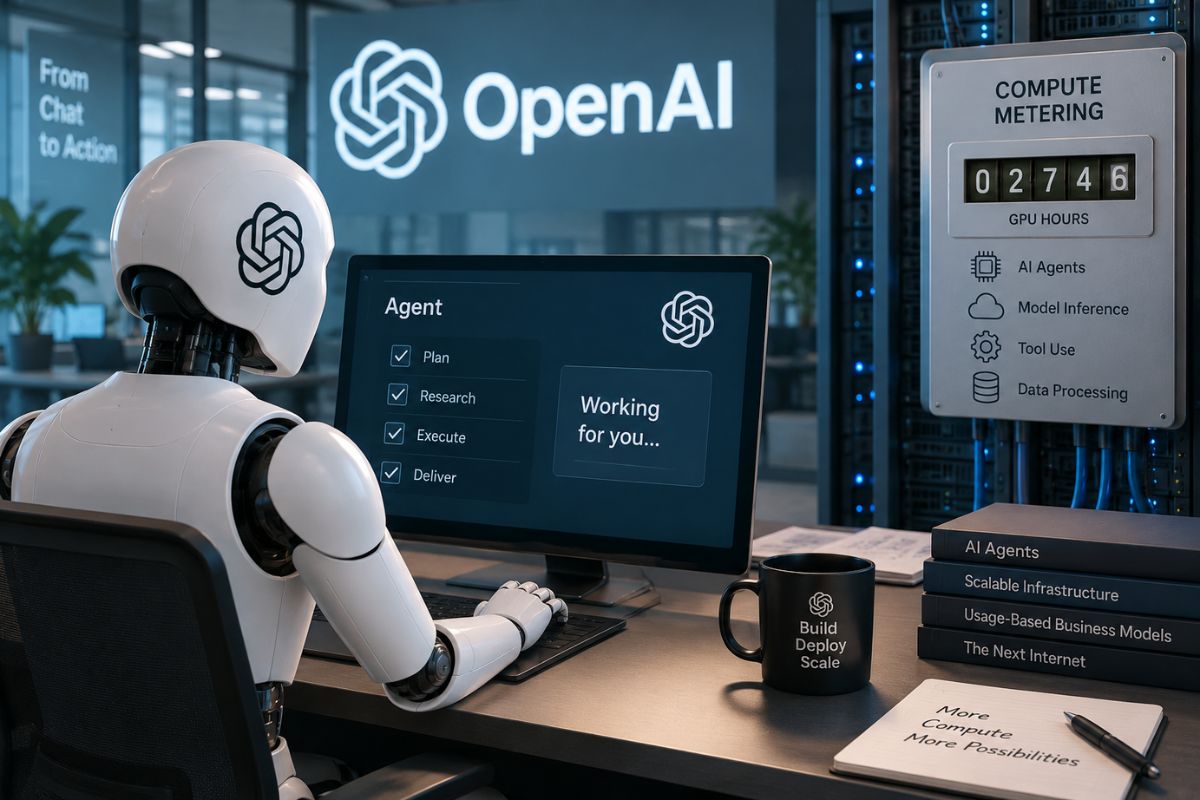
The OpenAI agentic business model shifts enterprise artificial intelligence from fixed-rate software subscriptions to variable cloud compute metering. Because autonomous agents run continuous logic loops, they multiply processing costs beyond what flat-rate pricing can sustain. OpenAI now operates exactly like Amazon Web Services, charging for raw compute time.
How do autonomous agents break flat-rate SaaS economics?
Autonomous agents break flat-rate software-as-a-service economics because their continuous, recursive reasoning loops multiply compute costs beyond what fixed monthly seat licenses can profitably cover. Autonomous agents are software systems designed to independently research data and execute multi-step logic workflows.
A quantified unit-economic breakdown reveals that when an artificial intelligence agent exceeds an average of 14 autonomous reasoning loops per workflow, fixed-fee enterprise seat licenses produce negative gross margins for model providers.
When an enterprise user queries a standard chatbot, the system processes one input and generates one output. Agentic systems bypass this traditional user experience. According to a July 2026 report by Gartner, this shift threatens $234 billion in enterprise software-as-a-service spending.
If an agent loops endlessly through recursive reasoning, the compute cost scales directly with each iteration. Maintaining fixed-fee enterprise seat licenses under this architecture guarantees that heavy enterprise users will generate financial losses. To survive, model providers must shift to a utility billing structure based on total token volume.
How does the OpenAI agentic business model transition to consumption billing?
The OpenAI agentic business model transitions to consumption billing by using monthly subscription fees as a minimum-spend revenue floor, charging enterprise customers for any overage tokens consumed beyond the baseline.
The enterprise software market historically treats artificial intelligence access as a standard application. Corporate procurement teams buy seat licenses for platforms like ChatGPT Enterprise. The actual contracts dictate a different financial structure entirely.
The cloud industry relies on FinOps for AI, which is a financial management discipline where enterprise buyers track and allocate cloud token usage to optimize costs. Instead of acquiring software users, AI providers secure minimum-spend compute commitments.
They charge enterprise customers for any overage tokens consumed beyond that baseline commitment. This structure forces enterprise buyers to manage token usage exactly as they would track Amazon Web Services Elastic Compute Cloud instances.
How does OpenAI’s metering stack mirror cloud infrastructure providers?
OpenAI’s metering stack directly mirrors cloud infrastructure providers by replicating features like Amazon Web Services Spot Instances through its Batch API and CloudFront edge caching through its Prompt Caching system. The product roadmap matches the infrastructure primitives built by hyperscalers over the last decade.
The translation between the two platforms is direct. OpenAI’s Batch API offers a 50% cost discount for asynchronous workloads, directly mirroring Amazon Web Services Elastic Compute Cloud Spot Instances.
Prompt Caching provides a 50% discount on recently seen input tokens. This functions as the equivalent of edge caching to reduce redundant processing costs. Distinct reasoning tiers map directly to compute-optimized versus memory-optimized hardware instances.
These features are not standard application updates. They are utility-metering controls designed to capture and manage continuous operational cloud budgets.
How does OpenAI’s strategy impact Microsoft Azure’s capital expenditures?
OpenAI’s strategy shifts massive physical hardware costs onto Microsoft Azure’s balance sheet, allowing OpenAI to extract high-margin software revenue while Microsoft absorbs data center depreciation. Capital expenditures refer to the funds a company uses to acquire and maintain physical assets like servers and data centers.
This shift puts OpenAI in direct structural competition with Microsoft Corporation, its primary infrastructure partner. OpenAI captures the high-margin revenue from selling software-scale compute intelligence directly to enterprises. Microsoft bears the physical risk of silicon obsolescence and commercial electricity contracts.
According to its July 2026 earnings report, Microsoft Corporation spent $41 billion on capital expenditures in a single quarter. The company primarily built out artificial intelligence data centers and Azure compute capacity. The arrangement effectively offloads hardware depreciation onto Microsoft, while OpenAI monetizes the logic layer on top.
How must IT budgets restructure to manage metered AI costs?
Information technology budgets must shift from deterministic annual seat licenses to active daily monitoring, as unpredictable agentic token consumption introduces massive monthly spending variance. Transitioning from predictable software seats to metered agentic tokens introduces severe budget volatility.
Cost control requires active tracking. According to the FinOps Foundation, 98% of FinOps teams now manage artificial intelligence spend. This urgency is driven by the unpredictability of bursty inference demand and runaway token consumption from infinite agent loops.
Enterprise deployment telemetry shows that autonomous agent workflows introduce a 250% to 350% monthly variance in departmental software spend, breaking conventional annual procurement models. Legacy software providers argue this billing structure creates unacceptable enterprise risk.
They maintain that flat-rate seats offer the financial certainty and deterministic audit trails that chief information officers require. Model providers counter that consumption-based metering aligns costs directly with business value. Enterprises pay only for the exact compute cycles used to solve a problem. Architectural advances continually drive down the cost per token over time.
Frequently Asked Questions
Why is OpenAI abandoning flat-rate subscription pricing?
OpenAI is shifting away from flat-rate subscriptions because autonomous agents run continuous reasoning loops that rapidly multiply compute costs. A quantified breakdown shows that exceeding 14 autonomous loops per workflow forces model providers into negative gross margins under fixed-fee pricing.
How does the OpenAI enterprise pricing model work now?
The OpenAI agentic business model operates on consumption billing, treating monthly subscription fees as a minimum-spend revenue floor. Enterprise customers are billed for any overage tokens they consume beyond their base commitment, effectively metering artificial intelligence like cloud infrastructure.
How are AI agents changing corporate IT budgets?
Autonomous agents introduce massive spending unpredictability, driving a 250% to 350% monthly variance in departmental software budgets. This volatility requires corporate information technology departments to adopt active FinOps monitoring instead of relying on predictable annual seat licenses.
Editorial Independence & Corrections
Clarity Times is published by Beeps Venture Technologies LLP under strict editorial independence charters. We uphold rigorous sourcing and verification protocols. Noticed a factual omission or error? Review our Correction Protocols or contact our editorial desk at mail@claritytimes.org.

Praseetha K
Investigative journalist and research analyst contributing independent field reports and structural analysis for Clarity Times.