At Clarity Times, we examine what mainstream narratives omit. This dispatch investigates institutional incentives, policy fine print, and multi-dimensional community impacts.
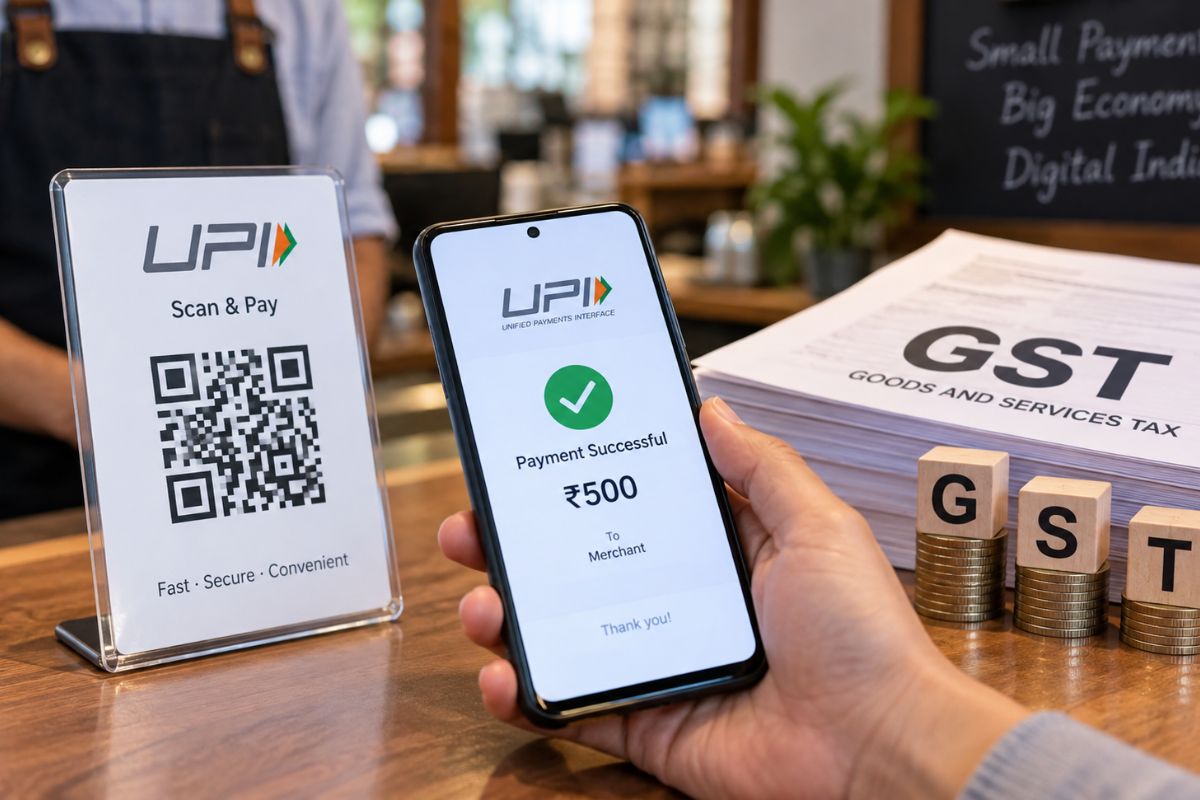
If your business is unregistered for the Goods and Services Tax, you will pay an unrecoverable 18% GST on UPI transactions subject to the new 0.4% merchant fee over ₹2,000. Indian tax law legally restricts input tax credits to registered businesses, making this charge a permanent cost for informal retailers.
Why Can’t Unregistered Merchants Claim Input Tax Credit on UPI Fees?
The government justifies the upcoming 0.4% Merchant Discount Rate (MDR) on UPI payments by pointing to the Input Tax Credit (ITC) mechanism. Officials have stated in press briefings that because merchants can claim back the 18% GST applied to the fee, the tax creates no extra burden on businesses.
That assurance is legally inapplicable to India’s smallest retailers. Under Section 22 of the Central Goods and Services Tax (CGST) Act, businesses selling goods with an annual turnover below ₹40 lakh, or services below ₹20 lakh, are exempt from GST registration.
Remaining unregistered is legal, but it severs a business from the credit chain. Section 16(1) of the CGST Act states that only a “registered person” is entitled to take credit for input tax charged on services, creating an absolute legal wall against unregistered entities reclaiming these costs. Because of this statutory limit, millions of unregistered merchants will absorb the GST on UPI fees as a permanent operational loss.
How Much Will the UPI MDR Fee Actually Cost Small Merchants?
Payment aggregators and banks must levy an 18% GST on their processing fees under the tax code’s SAC Code 9971. Because payment aggregators must deduct this statutory tax at the source before settling funds, the effective deduction for merchants unable to claim credit rises from 0.40% to 0.472%.
Aggregators cannot waive a statutory tax for unregistered entities. The nominal 0.4% MDR incurs an 18% GST, adding 0.072% to the total deduction regardless of the merchant’s GSTIN status.
For a ₹5,000 transaction, a merchant pays a ₹20 base fee plus ₹3.60 in GST. Without the ability to file a return and claim the ₹3.60 back, the math applies to every transaction crossing the ₹2,000 threshold.
Are GST Composition Scheme Dealers Exempt from the UPI Tax?
No, the 1.5 million Indian businesses registered under the GST Composition Scheme are explicitly prohibited by Section 10(4) of the CGST Act from claiming any input tax credit. The inability to recover this tax extends directly from the informal sector into formally registered small businesses.
The GST Council offers the Composition Scheme for businesses with a turnover up to ₹1.5 crore, allowing them to pay a flat tax rate – usually 1% or 5% – instead of filing complex monthly returns. Despite participating in the formal tax system, these dealers pay the 18% GST on their UPI fees directly out of their tight gross margins.
How Many Merchants Will Absorb the UPI GST Burden?
Comparing national payment infrastructure against tax registries reveals that the majority of physical endpoints accepting digital payments belong to entities outside the formal ITC network.
The official policy aims to protect daily micro-purchases at local markets and street vendors. But according to data from the National Payments Corporation of India (NPCI), the total number of active merchant UPI QR codes vastly exceeds the roughly 1.4 crore active GST registrations reported by the Goods and Services Tax Network (GSTN). The tax-offset mechanism cited by the Finance Ministry covers only a fraction of the merchants required to pay the fee.
Why Did the Finance Ministry Assume GST Would Not Burden Merchants?
When drafting the new UPI fee structure, policymakers modeled the tax flow on traditional card interchange systems – the backend networks where banks exchange transaction data and fees. Before the zero-MDR mandate for UPI, point-of-sale card terminals were predominantly deployed by formal corporate retailers who could naturally offset business-to-business tax debits.
The Ministry maintains that the UPI transaction limit of ₹2,000 specifically excludes micro-purchases. Officials argue that retailers consistently processing larger single tickets generate substantial turnover and should integrate into the formal tax system. The 0.4% base fee also remains significantly lower than global credit card MDRs, which typically range from 1.5% to 2.5%.
How Are Retailers Bypassing the ₹2,000 UPI Transaction Limit?
To avoid the unrecoverable 0.472% hit on higher-value sales, unregistered micro-merchants and consumers are actively restructuring how they accept payments. Merchants indicate two primary workarounds for bills exceeding the limit.
The first is transaction splitting. For a ₹3,500 repair bill, a vendor asks the customer to scan the QR code twice, authorizing one payment for ₹1,900 and a second for ₹1,600, keeping both under the fee threshold.
The second approach is a direct cash discount. By offering a ₹15 reduction on a ₹3,000 purchase if paid in cash rather than UPI, the merchant spends less than the ₹14.16 fee deduction, retaining the difference while avoiding the tax leakage entirely.
Frequently Asked Questions
Do I pay GST on UPI transactions if I don’t have a GST number? Yes. Payment aggregators deduct an 18% GST at the source on all MDR fees regardless of your registration status. Under Section 16(1) of the CGST Act, you cannot claim this tax back without a GST registration.
What is the actual deduction rate for merchants who cannot claim ITC? For unregistered merchants and composition dealers, the 18% GST on the 0.4% base fee acts as an unrecoverable surcharge. This raises the effective cost of accepting UPI payments over ₹2,000 from 0.40% to 0.472%.
Can a GST Composition Scheme dealer claim Input Tax Credit on UPI fees? No. While composition dealers are formally registered taxpayers, Section 10(4) of the CGST Act explicitly prohibits them from claiming any input tax credit. They must absorb the GST applied to their UPI merchant charges.
Editorial Independence & Corrections
Clarity Times is published by Beeps Venture Technologies LLP under strict editorial independence charters. We uphold rigorous sourcing and verification protocols. Noticed a factual omission or error? Review our Correction Protocols or contact our editorial desk at mail@claritytimes.org.

Praseetha K
Investigative journalist and research analyst contributing independent field reports and structural analysis for Clarity Times.