At Clarity Times, we examine what mainstream narratives omit. This dispatch investigates institutional incentives, policy fine print, and multi-dimensional community impacts.
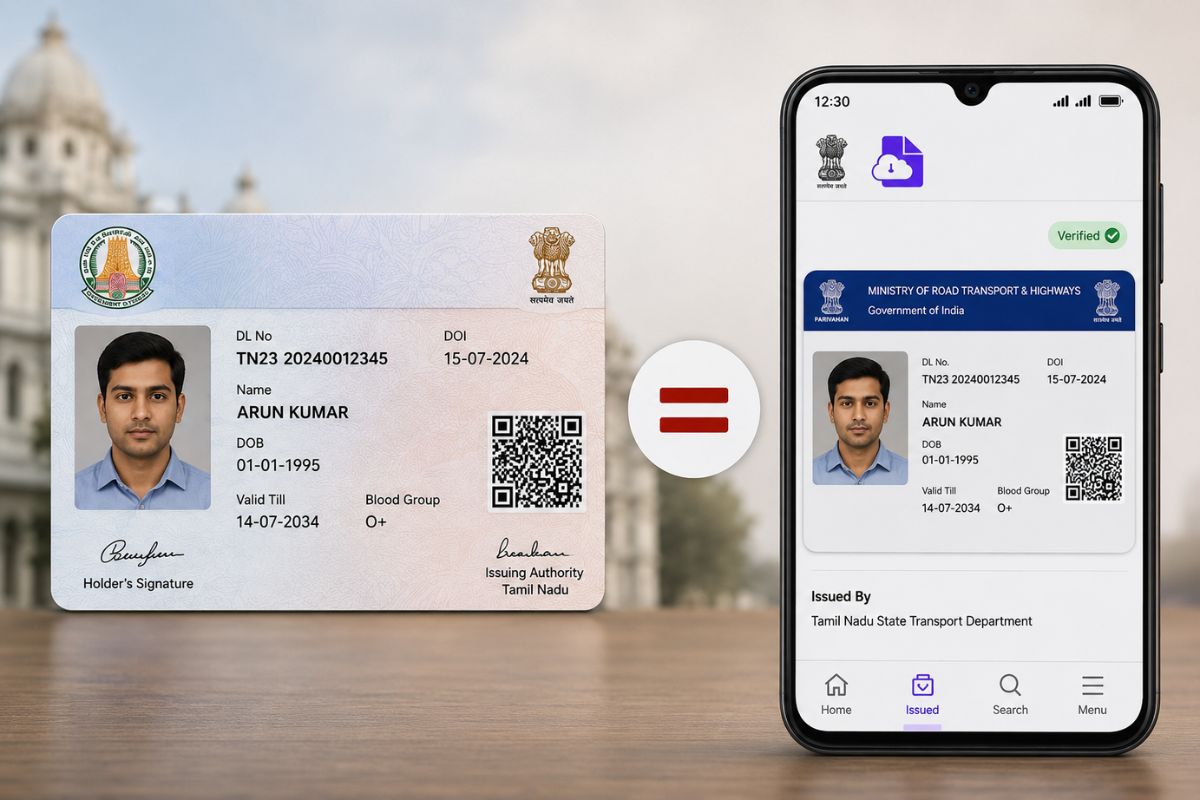
The upcoming Tamil Nadu digital driving licence offers the exact same documents citizens already access through the central government’s DigiLocker or mParivahan apps. The state’s new system does not generate new records. Instead, it acts as a localized, state-funded viewing window for the existing national transport database.
Comprehensive analysis and verified data remain essential for understanding complex market dynamics.
Clarity Times Research
How does the Tamil Nadu digital driving licence differ from DigiLocker?
The new state portal provides the exact same legally valid digital documents as DigiLocker, simply wrapped in a localized Tamil Nadu interface.
When the Tamil Nadu government announced a switch to paperless driving licences (DL) and registration certificates (RC) starting September 15, officials presented it as a technological shift. The administration promised instant, QR-coded downloads the same day a driver passes a test.
But Tamil Nadu residents have possessed this capability for years. Under a 2018 Ministry of Road Transport and Highways (MoRTH) notification, digital documents presented through the Union Government’s DigiLocker or mParivahan platforms hold the exact same legal validity as physical smart cards.
DigiLocker is a secure, cloud-based national platform established by the Ministry of Electronics and Information Technology to store and verify authentic government documents.
A review of mParivahan’s existing features shows it already provides the instant downloads, QR code verification for enforcement agencies, and same-day digital generation that the state government is now promising to build.
A driver pulled over in Chennai today can already present a verifiable, QR-coded licence on their smartphone. The state’s September 15 rollout builds a separate access point for a digital format that already exists.
Where does the new digital RC and DL portal get its data?
The Tamil Nadu portal pulls information directly from the National Informatics Centre (NIC), which already houses the central databases for licences and vehicle registrations.
Tamil Nadu is not constructing a new system to generate these digital documents. The underlying data lives in the centralized databases managed by the National Informatics Centre (NIC), the technology agency of the Indian government. Whenever a regional transport office (RTO) in Tamil Nadu issues a new licence, the record goes directly into the NIC’s Sarathi system.
According to the NIC’s technical architecture, state and enforcement applications do not house this data independently. They operate via application programming interfaces (APIs)-software bridges that allow two applications to exchange data-to fetch information from Vahan and Sarathi.
Rather than directing citizens to the central applications that pull from these databases, the state transport department is building a parallel digital pipeline. The new Tamil Nadu portal functions as a state-branded wrapper. It queries the exact same national servers mParivahan uses, returning identical information to the user.
Why is the state funding a separate digital portal?
The transport department is using taxpayer funds to contract private IT vendors, building a localized interface that replicates established federal platforms.
Building a localized portal to retrieve central data requires state funding. The transport department contracts private IT vendors to develop and maintain these redundant interfaces.
Public procurement records on the Tamil Nadu e-Procurement portal track how state departments allocate funds for software development and server maintenance. Taxpayer money is funding the security audits, vendor payouts, and ongoing hosting for a state portal that replicates the functions of an established, federally funded platform.
Why do transport officials say this new portal is necessary?
State authorities claim a bespoke portal reduces synchronization delays with central databases, ensuring same-day document availability and localized language support.
State authorities argue the parallel infrastructure solves specific local problems that central apps cannot address. While the transport department has not published a technical whitepaper outlining the portal’s advantages, officials routinely cite synchronization latency between state RTO servers and central databases.
If a central app takes several days to fetch new Tamil Nadu documents upon test completion, the state’s bespoke portal may offer genuine same-day downloads.
State-level deployment also enables a fully localized Tamil-language interface. It allows the digital download feature to integrate directly with specific RTO hardware for citizens requiring immediate physical reprints.
What changes for drivers who download their driving licence online?
The September 15 rollout introduces an “Anywhere Licensing” system that removes geographic boundaries for RTO services, but leaves questions about existing smart-card fees unanswered.
Regardless of backend redundancies, the September 15 launch changes the immediate procedure for new drivers. The state will offer an “Anywhere Licensing” system, removing geographic boundaries for RTO services.
The primary financial question for applicants concerns the physical card fees. Currently, applicants pay a ₹250 fee for chip-based driving licences and RCs, according to Times of India reporting on the Tamil Nadu transport department announcement. This fee covers printing and postal dispatch.
If the state retains this mandatory fee while eliminating the physical chip card and postal delivery for citizens who opt strictly for digital downloads, the digital shift functions as a new revenue stream. The true measure of the policy depends on whether the savings from going paperless reach the citizen or stay with the state.
Frequently Asked Questions
Is the Tamil Nadu digital driving licence legally valid?
Yes, the digital driving licence is fully valid. Under a 2018 Ministry of Road Transport and Highways notification, electronic documents presented via state portals or apps like DigiLocker hold the exact same legal status as physical smart cards.
Do I still need to pay the ₹250 fee for a digital driving licence?
The Tamil Nadu government has not yet clarified if the ₹250 fee for printing and dispatching a physical smart card will be waived. If the fee remains mandatory for users opting only for a digital download, it effectively becomes a new state revenue stream.
How is the new state portal different from mParivahan?
The new Tamil Nadu portal functions identically to mParivahan by pulling records from the central Sarathi and Vahan databases. State officials argue the localized portal will eliminate sync delays and provide a better Tamil-language interface.
Editorial Independence & Corrections
Clarity Times is published by Beeps Venture Technologies LLP under strict editorial independence charters. We uphold rigorous sourcing and verification protocols. Noticed a factual omission or error? Review our Correction Protocols or contact our editorial desk at mail@claritytimes.org.

Praseetha K
Investigative journalist and research analyst contributing independent field reports and structural analysis for Clarity Times.