At Clarity Times, we examine what mainstream narratives omit. This dispatch investigates institutional incentives, policy fine print, and multi-dimensional community impacts.
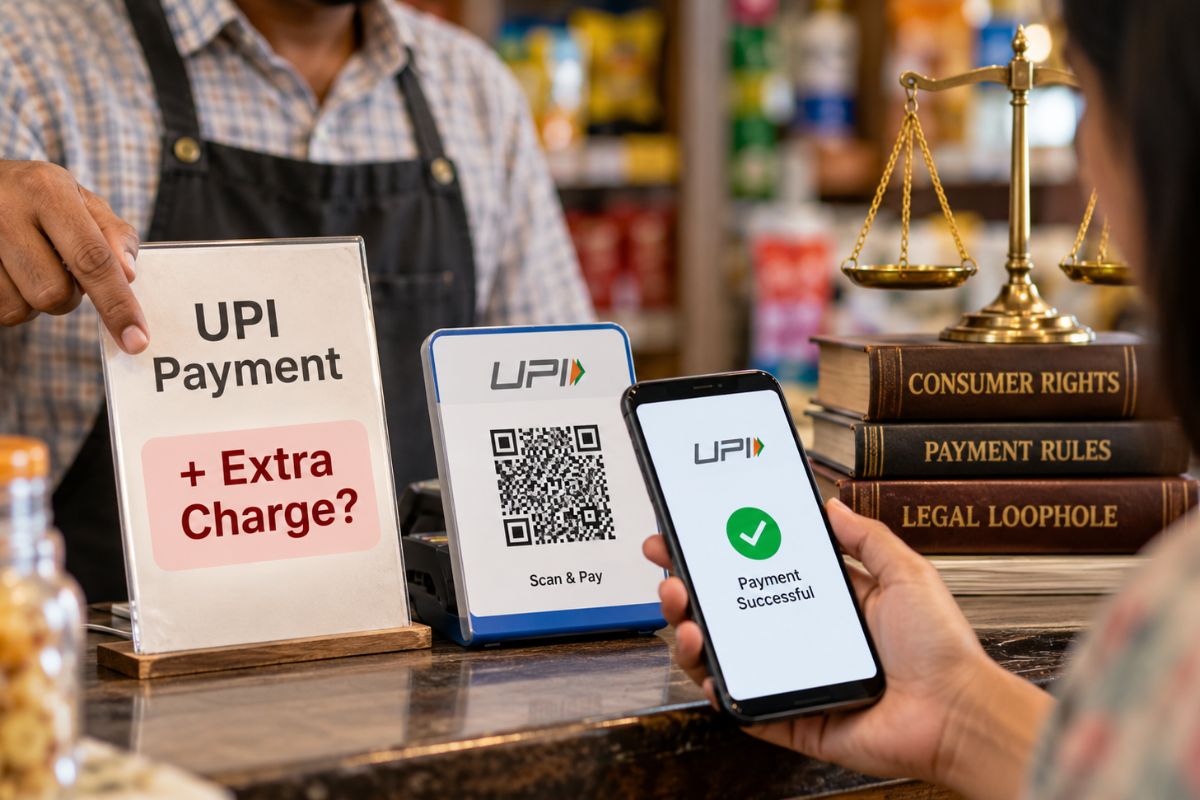
Technically, a shopkeeper is well within their legal rights to charge you extra for UPI transactions exceeding ₹2,000. Although government officials assure the public that the new 0.4% Merchant Discount Rate won’t affect consumers, current Indian law offers no actual enforcement mechanism to prevent merchants from applying convenience fees or simply incentivizing cash payments through discounts.
Is there a law against adding a UPI convenience fee?
Currently, no Indian law penalizes a shopkeeper for adding a UPI convenience fee to a bill. The Finance Ministry recently advised banks to ensure merchants do not pass the upcoming fee to buyers. This advice carries no legal penalty for the shopkeeper.
The regulatory framework governing digital payments, the Payment and Settlement Systems Act (PSSA), 2007, dictates how banks and payment gateways interact. (The PSSA is the primary Indian statute that empowers the Reserve Bank of India to regulate payment systems and clearing houses.) It does not regulate retail point-of-sale pricing.
According to legal analysts reviewing the statute, the PSSA lacks any penal provision that would make it a crime for a shopkeeper to levy a surcharge at the billing counter. Without a statutory provision, a merchant adding an ₹8 charge to a ₹2,000 transaction is not breaking the law; they are simply making a retail pricing decision.
| Regulatory Body | Jurisdiction | Enforcement Power Over Retailers |
|---|---|---|
| RBI Ombudsman | Banks & Payment Gateways | None |
| Acquiring Banks | Merchant QR Codes | Contractual (Rarely Enforced) |
| Govt / Finance Ministry | Policy Guidance | No Statutory Penalty |
How will merchants pass the UPI MDR over 2000 to customers?
Merchants plan to pass the UPI MDR over 2000 to customers by reviving dual-pricing, offering cash discounts to offset the 0.4% fee. Retailers operating on thin margins plan to bypass the banking guidelines entirely. A 0.4% top-line revenue hit on a low-margin appliance or bulk grocery order absorbs a significant portion of a store’s net profit.
To recover this, merchant associations and retailers are preparing structural pricing workarounds that avoid explicitly violating their banking agreements on paper.
The primary method will be the revival of dual-pricing. Industry observers anticipate merchants will set the sticker price to include the 0.4% fee, then offer a “cash discount” for customers who pay in physical currency. Alternatively, retailers plan to split bills into multiple smaller transactions below the ₹2,000 threshold to dodge the charge altogether. The fee is passed on without ever appearing as a line-item surcharge on a printed receipt.
Can the RBI banking ombudsman resolve a UPI charge complaint?
The RBI banking ombudsman cannot resolve a UPI charge complaint against a retailer because its jurisdiction is strictly limited to regulated financial entities. Consumers facing these extra charges have no regulatory body to turn to.
The Reserve Bank – Integrated Ombudsman Scheme, 2021, handles complaints about failed transactions, bank fraud, and banking service failures. (The RBI banking ombudsman is a senior official appointed to redress customer grievances against regulated financial institutions.) Its jurisdiction ends at the “Regulated Entity”, meaning the bank, payment gateway, or system participant.
An ombudsman can penalize a financial institution for levying an unauthorized charge on an account. They cannot penalize a neighborhood pharmacy for changing the total on a bill before the customer scans the QR code.
What is the government’s plan to enforce the 0.4% UPI MDR rule?
The government expects acquiring banks to enforce the 0.4% UPI MDR rule by threatening to terminate the QR codes of merchants caught surcharging. Starting October 15, 2026, according to the National Payments Corporation of India, a 0.4% Merchant Discount Rate will apply to Person-to-Merchant UPI transactions above ₹2,000.
The government maintains that this policy targets corporate retailers while shielding consumers, with Finance Minister Nirmala Sitharaman recently asserting that the charge will not be passed down. The official enforcement mechanism relies on acquiring banks, who hold the contractual power to terminate the QR code of a merchant caught surcharging.
Will banks stop merchants from adding a UPI fee?
Banks are unlikely to stop merchants from adding a UPI fee because doing so would risk losing profitable commercial clients to competitors. Relying on banks to police merchant pricing has a documented track record of failure.
For decades, standard merchant-acquiring contracts and RBI guidelines governing credit cards have forbidden shopkeepers from passing payment processing fees to customers. Yet, adding a 2% fee for credit card payments remains a standard practice at independent electronics, hardware, and jewelry stores across the country.
Banks rarely terminate merchant accounts for surcharging because doing so means losing a commercial client to a competing bank. The UPI ecosystem operates on the exact same incentive structure.
Frequently Asked Questions
Can I complain to the RBI if a shop charges me a UPI fee?
No. The RBI banking ombudsman only has jurisdiction over regulated financial entities like banks and payment gateways. They cannot penalize a retail shopkeeper for adding a convenience fee to your bill.
Is it illegal for a shopkeeper to ask for extra money for a UPI payment?
Currently, it is not illegal. The Payment and Settlement Systems Act, 2007, does not contain any statutory penalty that prohibits retailers from adjusting point-of-sale pricing to cover their processing costs.
How will shops charge the UPI fee without violating their bank agreements?
Many retailers plan to bypass bank rules by reviving dual-pricing. They will bake the 0.4% Merchant Discount Rate into the sticker price of the product and offer a cash discount to buyers who use physical currency instead.
Editorial Independence & Corrections
Clarity Times is published by Beeps Venture Technologies LLP under strict editorial independence charters. We uphold rigorous sourcing and verification protocols. Noticed a factual omission or error? Review our Correction Protocols or contact our editorial desk at mail@claritytimes.org.

Praseetha K
Investigative journalist and research analyst contributing independent field reports and structural analysis for Clarity Times.