At Clarity Times, we examine what mainstream narratives omit. This dispatch investigates institutional incentives, policy fine print, and multi-dimensional community impacts.
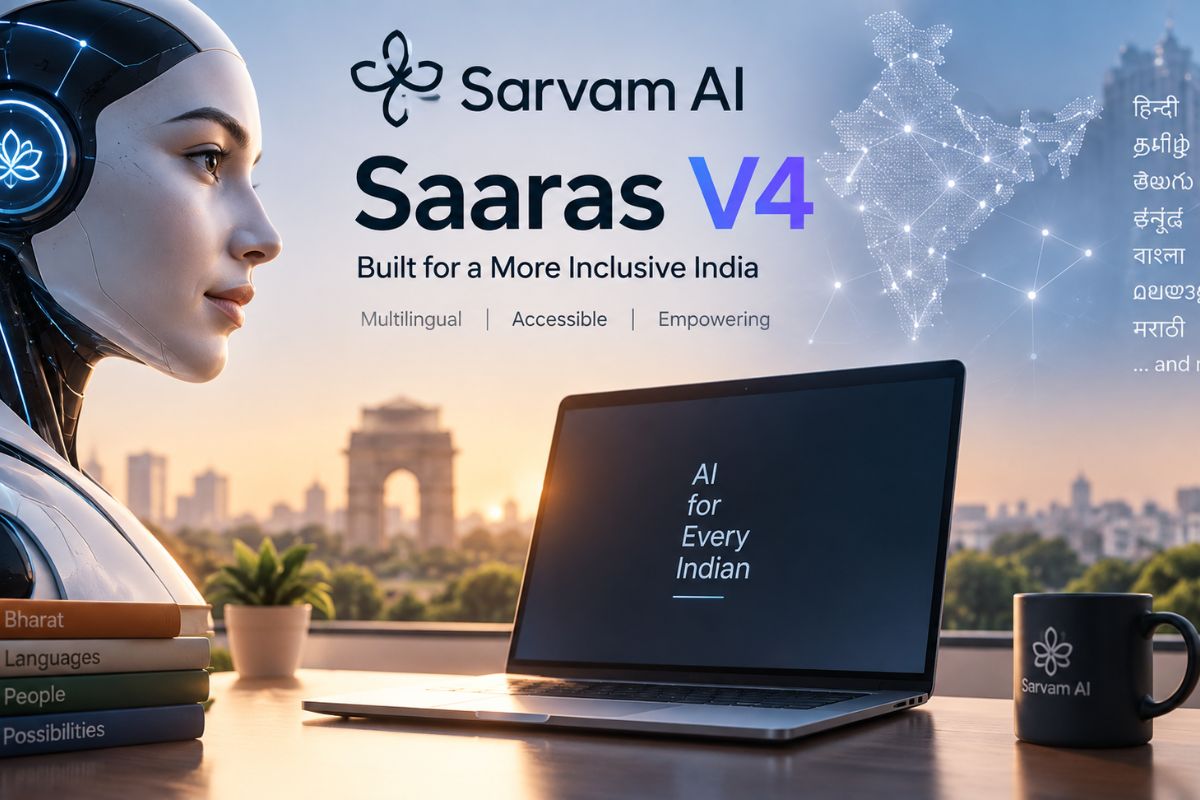
Sarvam AI engineered the Saaras V4 speech model explicitly for Global English and telephony audio, strategically targeting India’s lucrative $44 billion voice outsourcing market. While public communications highlight rural vernacular accessibility, the model’s 8kHz architecture and highly aggressive pricing are intentionally designed to displace established US enterprise vendors within commercial call centers.
Why Does Saaras V4 Rely on 8kHz Telephony Audio?
Saaras V4 is optimized for 8kHz narrow-band audio because commercial call centers operate on highly compressed telephone networks, not high-fidelity smartphone connections. Narrow-band 8kHz audio samples sound 8,000 times per second—the global standard for voice telephony—intentionally stripping out higher frequencies to conserve network bandwidth.
While mainstream coverage positioned the release as a digital bridge for rural India, the technical specifications indicate a distinct commercial objective. Modern consumer applications transmit wideband audio ranging from 16,000Hz (16kHz) to 44,100Hz (44.1kHz). Conversely, enterprise call centers, constrained by legacy VoIP infrastructure and private branch exchange (PBX) systems, process audio at 8kHz.
According to Sarvam AI’s official API documentation, the model is “optimized for 8KHz telephony audio.” Transcribing compressed, low-fidelity telephone audio demands specialized acoustic weights. Models trained solely on high-fidelity audio degrade significantly on phone lines; thus, 8kHz telephony optimization is a strict functional requirement for call-center deployment.
How Does Saaras V4 Pricing Compare to OpenAI Whisper and Microsoft Azure?
Sarvam AI prices Saaras V4 speech-to-text at roughly ₹30 ($0.36) per hour. This pricing matches OpenAI Whisper’s base rate while undercutting Microsoft Azure Speech Services by approximately 64%. Based on Microsoft Azure’s standard rate of $1.00 per hour, a call center transcribing one million minutes monthly stands to save over $10,000 by transitioning to Sarvam AI.
| Provider | Model / Service | Estimated Cost Per Hour |
|---|---|---|
| Microsoft | Azure Speech Services | $1.00 |
| OpenAI | Whisper (API) | $0.36 |
| Sarvam AI | Saaras V4 | $0.36 (₹30) |
This aggressive pricing strategy directly appeals to the unit economics of Indian Business Process Management (BPM) firms managing customer support for Western enterprises, where voice transcription constitutes a massive operational expense.
According to Sarvam AI’s launch announcement, the model achieves sub-150ms latency for streaming applications. This response time rivals major US cloud providers on interactive voice agents, but without the legacy price premium.
Why Is Sarvam AI Targeting Call Centers Instead of Civic Tech?
Sarvam AI is aggressively pursuing the voice outsourcing sector because India’s domestic civic software market yields low contract values, whereas the export-driven Business Process Management industry generates over $44 billion annually.
Data from the National Association of Software and Service Companies (NASSCOM) indicates that Indian BPM firms command nearly 40% of global sourcing expenditure. Capturing enterprise transcription budgets provides venture-backed AI startups with a viable path to profitability that domestic civic contracts simply cannot support.
Sarvam AI asserts that this enterprise commercialization ultimately funds its broader mission. In its launch announcement, the company highlighted that V4 achieves state-of-the-art accuracy across 22 Scheduled Indian languages, noting the release “reaffirms our commitment to even the most low-resource Indian languages.” Commercial revenue from lucrative English workloads effectively subsidizes the development of non-commercial regional dialects.
What Are the Core Technical Capabilities of Saaras V4?
Saaras V4 is a 3-billion-parameter speech recognition model built on a highly efficient hybrid state-space architecture. This architecture processes sequential data with significantly lower memory consumption than standard transformer models, facilitating rapid transcription over extended audio streams.
The model supports five distinct output modes: verbatim, normalized, code-mixed, transliterated, and direct English translation. Code-mixing—the fluid alternation between languages within a single utterance—is natively supported, reflecting authentic Indian conversational patterns.
Furthermore, the system features a robust automated language identification module. Across all 22 official Indian languages, Sarvam AI reports a highly competitive language identification error rate of just 5.22%.
What Challenges Does Sarvam AI Face in Replacing US Tech Providers?
Enterprise adoption of Indian-developed voice AI necessitates passing stringent corporate compliance audits and demonstrating unwavering reliability across diverse regional English dialects. Compelling cost savings alone are rarely sufficient to convince risk-averse global enterprises to adopt an unproven vendor.
Although Sarvam AI reported the lowest Word Error Rate on seven global English datasets, enterprise call centers manage a vast array of non-native dialects. Accents originating from regional UK, Australia, and the American South present critical edge cases that require rigorous evaluation prior to live deployment.
Regulatory compliance poses an even steeper barrier to entry. Export call centers process highly regulated personal data from Western consumers. Corporate risk officers must unequivocally verify that vendor infrastructure adheres to System and Organization Controls 2 (SOC 2) and the European Union’s General Data Protection Regulation (GDPR) before authorizing the transmission of voice data through a new startup’s servers.
Frequently Asked Questions
Why did Sarvam AI optimize Saaras V4 for 8kHz audio?
Enterprise call centers and legacy telephone systems compress voice data to 8kHz to conserve network bandwidth. By training Saaras V4 on 8kHz audio, Sarvam AI made the model compatible with commercial PBX phone lines rather than just smartphone applications.
How much cheaper is Saaras V4 than US enterprise speech models?
Sarvam AI charges ₹30 per hour (about $0.36) for speech-to-text. This matches OpenAI Whisper’s base rate and is 64% cheaper than Microsoft Azure Speech Services, which charges $1.00 per hour for standard transcription.
What is the commercial strategy behind adding Global English to Saaras V4?
Adding Global English allows Sarvam AI to compete for contracts in India’s $44 billion voice outsourcing market. Export call centers need high-volume, low-cost English transcription to service overseas clients, offering far higher revenue than domestic vernacular pilots.
What compliance standards must Sarvam AI meet to enter global call centers?
To win contracts with international call centers, Sarvam AI must comply with data privacy standards such as SOC 2 and GDPR. Enterprise clients require strict data residency and security assurances before routing customer call recordings to a third-party AI provider.
Editorial Independence & Corrections
Clarity Times is published by Beeps Venture Technologies LLP under strict editorial independence charters. We uphold rigorous sourcing and verification protocols. Noticed a factual omission or error? Review our Correction Protocols or contact our editorial desk at mail@claritytimes.org.

Praseetha K
Investigative journalist and research analyst contributing independent field reports and structural analysis for Clarity Times.