At Clarity Times, we examine what mainstream narratives omit. This dispatch investigates institutional incentives, policy fine print, and multi-dimensional community impacts.
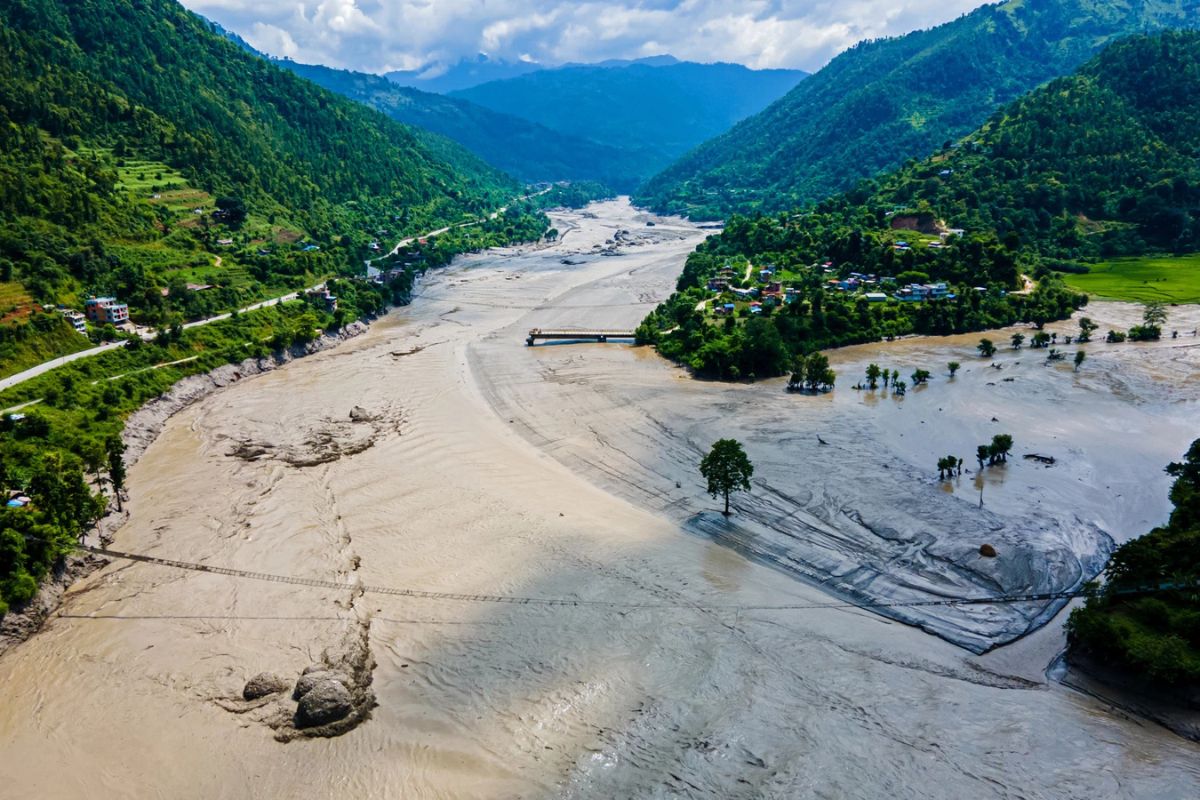
The August 26 glacier collapse will eliminate roughly $380 million in projected Nepal hydropower export revenues to India over the next 18 months. Because insurance policies cap flood payouts, the destruction of 12 hydropower projects leaves state utilities and banks exposed to over $1.4 billion in unhedged construction debt.
How Much Will Nepal Hydropower Export Revenues Drop After the Flood?
According to export calculations based on Nepal Electricity Authority dispatch schedules, the destruction of 12 hydropower plants will wipe out approximately $380 million in cross-border electricity sales to India over the next 18 months.
The sudden glacial collapse along the Nepal-Tibet border instantly disabled 1,100 megawatts of active and imminent generating capacity in the Trishuli and Chilime river basins. The Nepal Electricity Authority—the state-owned monopoly utility managing power generation, transmission, and cross-border trade—heavily relies on these wet-season river flows to sell surplus power to Indian buyers.
Based on cross-border dispatch schedules and recent earnings reports from the utility, as well as seasonal day-ahead clearing prices on the Indian Energy Exchange, this supply disruption effectively zeroes out projected bilateral export earnings through the 2027 monsoon.
Ministry of Energy, Water Resources and Irrigation officials state that this revenue loss will not cause domestic blackouts. Wet-season generation typically produces a domestic surplus, meaning the offline capacity cuts off excess export income rather than power dispatched to Nepali homes.
Who Holds the Construction Debt on the Damaged Hydropower Projects?
International development lenders and domestic commercial bank syndicates hold over $1.4 billion in outstanding construction debt across the damaged projects.
Developing the Trishuli and Chilime river corridors required heavy borrowing split across multilateral financiers, bilateral state lenders, and local institutions. The Trishuli hydropower flood damage directly affects assets backed by project finance debt packages arranged by the Asian Development Bank and the International Finance Corporation, alongside concessional lending lines extended by the Export-Import Bank of China.
Domestic commercial banks in Nepal hold roughly 45 billion NPR (approximately $335 million) in direct loan exposure to the flooded private hydropower developers, according to syndicated project registries.
Under Nepal Rastra Bank’s priority sector lending rules, commercial lenders must direct at least 10 percent of their total loan portfolios into energy. Loan-loss provisioning is the mandatory capital reserve that banks must set aside to cover potential loan defaults. Because these assets are no longer producing revenue, local banks face sharp provisioning increases that freeze lending capital across the broader economy.
| Financial Impact Area | Estimated Cost / Exposure | Timeline |
|---|---|---|
| Lost Export Revenues (India) | $380 Million | Next 18 Months |
| Uncovered Physical Damage | $750 Million | Immediate |
| Domestic Commercial Bank Exposure | $335 Million (45B NPR) | Ongoing |
| Total Unhedged Construction Debt | $1.4 Billion | Long-term |
How Does the Damage Affect the Nepal-India Power Trade Agreement?
The destruction of the Trishuli-Chilime plants creates an immediate deficit in Nepal’s export pipeline, but energy planners argue other river basins can preserve long-term targets.
Hydropower exports serve as the core pillar of Nepal’s macroeconomic growth plan. In January 2024, the two nations finalized the Nepal-India power trade agreement, an official pact establishing a framework to export 10,000 megawatts of electricity to India over 10 years.
The loss of 1,100 megawatts from a single river corridor removes near-term dispatch capacity committed to cross-border trading desks. State utility officials counter that projects totaling over 3,000 megawatts remain under active development in the Koshi and Karnali river systems, providing alternative export capacity as those projects reach commissioning.
Why Won’t Insurance Policies Cover the Hydropower Rebuild Costs?
Standard infrastructure insurance policies registered with the Insurance Authority of Nepal cap payouts for glacial outburst floods at 20 to 25 percent of total project value, leaving an estimated $750 million in physical damage uncovered.
A glacial lake outburst flood occurs when a natural moraine dam holding a high-altitude alpine lake abruptly fails, releasing a catastrophic torrent of water, boulders, and sediment downstream. Under narrow definitions of flood and landslide perils filed with the Insurance Authority of Nepal—the national insurance regulatory body—insurers limit exposure to these high-altitude events through strict sub-limits.
Under standard power purchase agreements—the legal contracts specifying electricity pricing and delivery terms between independent power producers and the utility—uninsurable natural catastrophes trigger force majeure clauses. These clauses legally release developers from supply obligations and shift residual reconstruction liabilities onto developer equity and state balance sheets.
The Independent Power Producers’ Association, Nepal—which noted that the destruction of the 12 projects erased billions of rupees in physical capital—states that developers complied with every state-mandated engineering code during construction. The association argues that damage from changing alpine glacial systems requires international climate loss-and-damage grant funding rather than balance-sheet write-downs by private developers.
How Will the Disaster Strain Nepal’s Foreign Debt and Currency Reserves?
Servicing sovereign debt on non-generating hydropower projects will consume an estimated 1.8 percent of Nepal’s annual foreign exchange reserves over the next fiscal cycle, according to repayment data from the Public Debt Management Office.
The Ministry of Finance must service sovereign-guaranteed external loans on public infrastructure assets even while those plants generate zero revenue. This fiscal outflow coincides with Nepal’s preparations to graduate from the United Nations Least Developed Country category, a transition that phases out access to low-interest concessionary loans.
According to Public Debt Management Office amortization tables cross-referenced against annual foreign exchange reserves tracked by Nepal Rastra Bank, meeting scheduled loan repayments on the damaged state facilities will draw down nearly 2 percent of total national reserves unless sovereign lenders approve debt deferrals or maturity extensions.
Frequently Asked Questions
How will the Nepal glacier collapse affect Nepal hydropower export revenues?
The loss of 1,100 megawatts across 12 damaged projects will eliminate an estimated $380 million in projected electricity sales to India over the next 18 months. These losses hit wet-season surplus exports sold on the Indian Energy Exchange and through bilateral agreements.
Why does the disaster leave $1.4 billion in unhedged construction debt?
Developing the damaged projects required more than $1.4 billion in loans from multilateral lenders like the Asian Development Bank and domestic commercial banks. Because the plants cannot generate power to service their debt, and insurance policies cap disaster payouts, lenders and operators must absorb the financing costs.
Will the hydropower damage cause domestic power blackouts in Nepal?
No. Ministry of Energy officials report that wet-season power output regularly exceeds domestic demand, meaning the offline capacity cuts into surplus electricity meant for export rather than base power supplies for domestic households.
Why won’t insurance cover the cost of rebuilding the dams?
Commercial insurance policies in Nepal carry sub-limits that cap payouts for glacial lake outburst floods at 20 to 25 percent of total asset value. This limitation leaves roughly $750 million in reconstruction costs uncovered across the affected projects.
How does this disaster affect Nepal’s 10,000 MW export pact with India?
The damage eliminates near-term export capacity from the Trishuli basin, but government planners expect more than 3,000 megawatts under construction in the Koshi and Karnali basins to keep the 10-year, 10,000-megawatt bilateral export target on track.
Editorial Independence & Corrections
Clarity Times is published by Beeps Venture Technologies LLP under strict editorial independence charters. We uphold rigorous sourcing and verification protocols. Noticed a factual omission or error? Review our Correction Protocols or contact our editorial desk at mail@claritytimes.org.

Praseetha K
Investigative journalist and research analyst contributing independent field reports and structural analysis for Clarity Times.