At Clarity Times, we examine what mainstream narratives omit. This dispatch investigates institutional incentives, policy fine print, and multi-dimensional community impacts.
The UK government subsidizes promotional campaigns for British food brands in Indian supermarkets to fulfill statutory post-Brexit export growth targets mandated by Parliament. Through the Food Campaign India initiative, the Department for Business and Trade strategically deploys public funds to underwrite these overseas retail activations, aiming to generate robust and measurable export metrics.
Why did the Department for Business and Trade launch the Indian supermarket campaign?
The Department for Business and Trade (DBT)—responsible for negotiating international trade policy and driving business growth—operates under strict statutory obligations to expand non-EU export volumes. Following the implementation of bilateral trade agreements, government agencies faced mounting political pressure to demonstrate tangible commercial returns in major Commonwealth economies. Departmental planning establishes a clear mandate: utilize state-backed promotional frameworks to increase British food and drink market share abroad, transferring the initial financial risk of market entry from private enterprises to the public purse.
How are public funds allocated for South Asian retail activations?
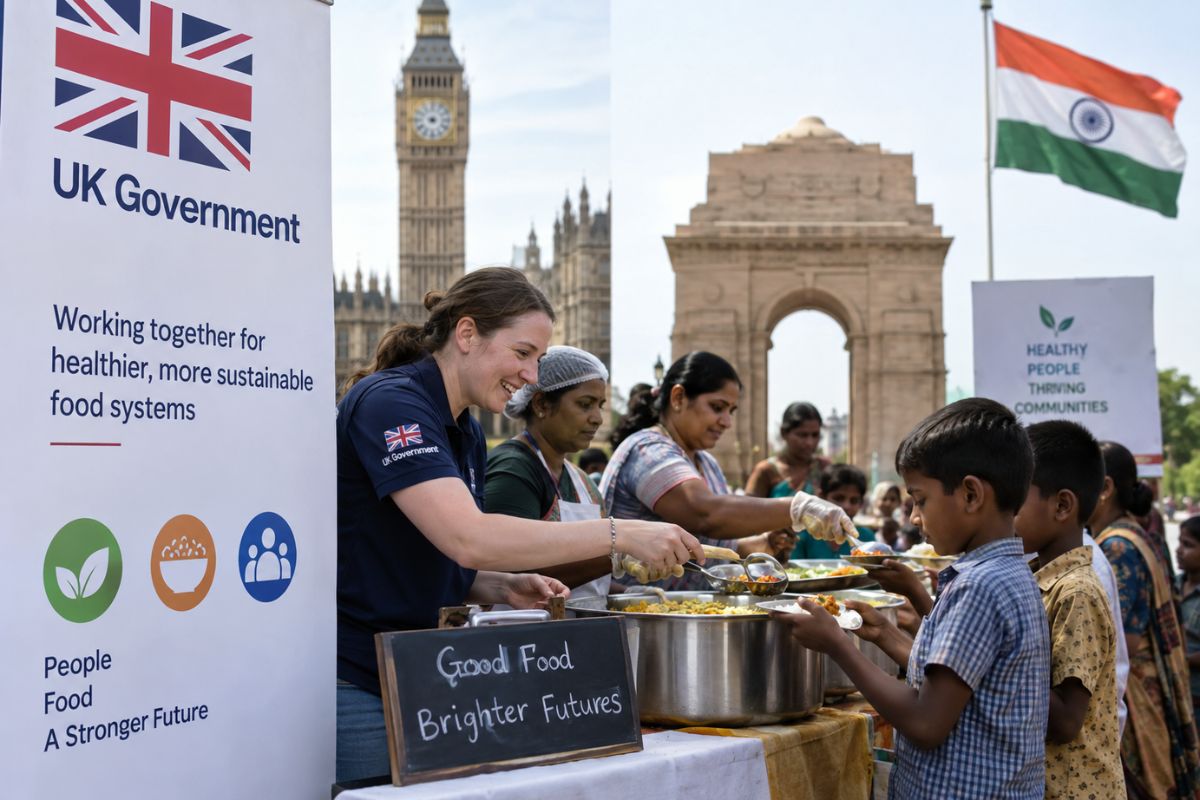
Public expenditure data and official deployment mechanics are detailed in the Business.gov.uk Export to India framework. Under these grant mechanisms, the DBT directly co-funds marketing partnerships with high-end grocery chains such as Food Square and Food Stories. These arrangements absorb a significant portion of the upfront capital required for in-store merchandising, tastings, and catalog placements across major hubs like Mumbai, New Delhi, Ahmedabad, Hyderabad, and Bengaluru, substantially offsetting operational expenses for participating UK brands.
What separates the public campaign launch from actual supermarket reality?
Publicly, the month-long “Great Food From Great Britain” campaign features nearly 1,000 UK food and beverage SKUs displayed across gourmet retail outlets. Mainstream reports often frame the rollout as a straightforward commercial celebration of lowered trade barriers, emphasizing consumer discovery of traditional items like biscuits, teas, and cheeses, while largely ignoring the administrative machinery financing these displays.
How do trade officials use Key Performance Indicators to justify domestic spending?
To justify public expenditure to Parliament, trade officials rely on specific performance metrics outlined in Food and Drink Federation trade reports. According to departmental oversight reviews, success is primarily gauged by export volume growth figures and retail partnership counts rather than long-term consumer retention. Civil servants report these milestone metrics back to domestic legislators as definitive proof of post-Brexit trade expansion, frequently treating temporary promotional events as permanent market penetration.
| Performance Indicator | Assessment Focus | Limitation |
|---|---|---|
| Initial Export Volume | Bulk shipments for campaign launch | Fails to measure sustained demand |
| Retail Partnership Count | Number of store placements secured | Temporary; often reliant on subsidies |
| Re-order Velocity | Post-promotion inventory replenishment | Reveals actual long-term market viability |
Does government-backed promotion reflect organic market demand?
A significant gap remains between government-tracked export milestones and actual commercial re-order rates in Indian supermarkets. Data from the FDF Q1 Trade Snapshot analysis—compiled by the Food and Drink Federation—compares non-EU export data against post-promotion inventory velocity in international metro retail. According to the analysis, global food and drink export volumes fell 8.9% year-on-year, underscoring the political pressure behind government-subsidized retail pushes. While official reports tally initial bulk shipments, subsequent shelf replenishment data often reveals steep declines once promotional subsidies expire and high tariff brackets are reinstated.
Representatives for the DBT defend the strategy, arguing that government-backed brand awareness campaigns provide a crucial foundational step for small and medium-sized enterprises entering high-barrier foreign markets. Trade officials maintain that public co-funding bridges the initial information gap for British exporters unfamiliar with complex South Asian retail logistics.
Frequently Asked Questions
Why is the UK government funding food promotions in Indian supermarkets?
The UK government funds these promotions to satisfy statutory post-Brexit export growth requirements mandated by Parliament, using public grants to help domestic food brands penetrate high-barrier foreign markets.
How does the Department for Business and Trade support retail activations abroad?
The Department for Business and Trade co-funds marketing partnerships with high-end grocery chains, absorbing upfront costs for in-store merchandising, consumer tastings, and catalog placements.
Do short-term promotional campaigns result in long-term sales growth in India?
While government reports track initial bulk export shipments and campaign counts, subsequent inventory data frequently reveals sharp declines in re-orders once promotional subsidies end and standard import tariffs apply.
What metrics do trade officials report to Parliament to justify spending?
Trade officials evaluate program success based on export volume growth figures and retail partnership counts rather than long-term consumer retention or permanent store placement.
Editorial Independence & Corrections
Clarity Times is published by Beeps Venture Technologies LLP under strict editorial independence charters. We uphold rigorous sourcing and verification protocols. Noticed a factual omission or error? Review our Correction Protocols or contact our editorial desk at mail@claritytimes.org.

Praseetha K
Investigative journalist and research analyst contributing independent field reports and structural analysis for Clarity Times.