At Clarity Times, we examine what mainstream narratives omit. This dispatch investigates institutional incentives, policy fine print, and multi-dimensional community impacts.
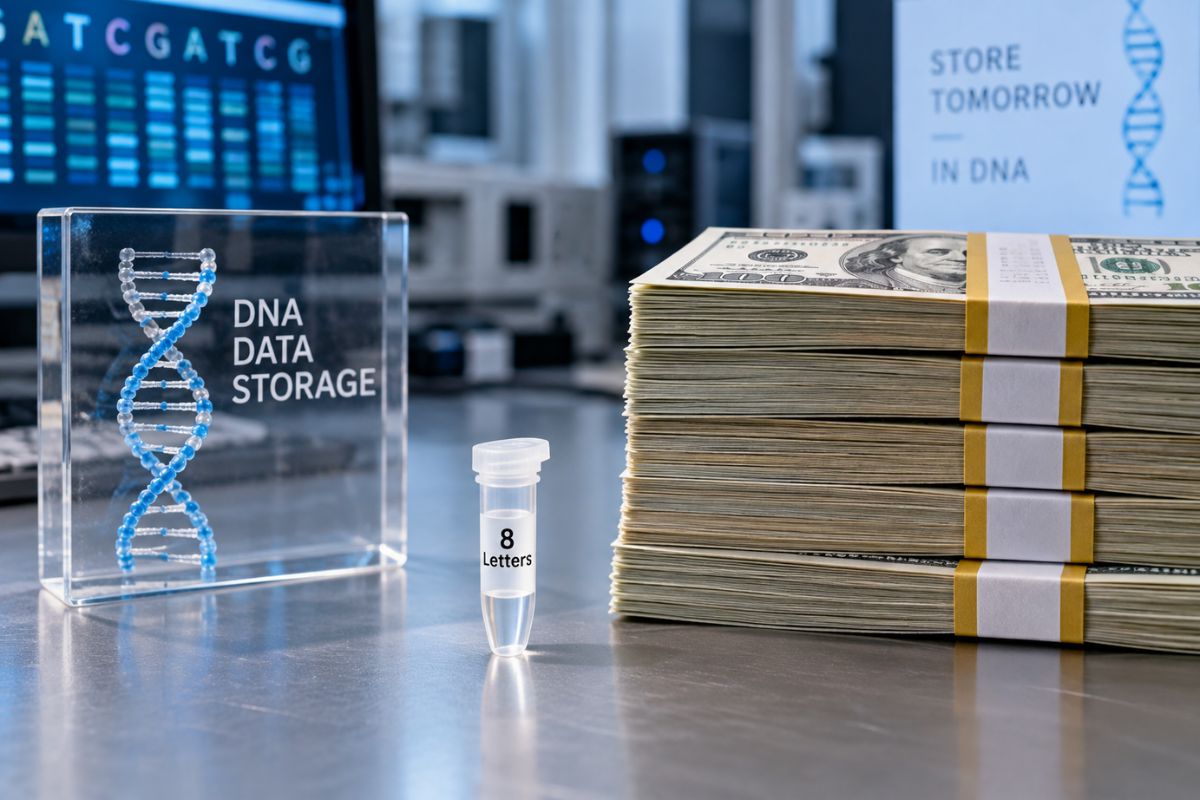
The financial realities of eight-letter Hachimoji DNA render it currently prohibitive for enterprise data storage, carrying a per-megabyte synthesis cost 500 to 1,500 times higher than standard four-letter DNA. Although the inclusion of four synthetic nucleotides boosts theoretical information density by 50 percent, the reliance on bespoke chemical manufacturing pipelines and necessary error-correction redundancy effectively prevents commercial viability in modern data archiving applications.
Specifically, the theoretical capacity advantage of an eight-letter genetic alphabet is currently erased by a 500-to-1,500-fold premium in synthesis costs per readable megabyte.
How Much Does 8-Letter DNA Data Storage Cost?
Synthesizing an eight-letter sequence currently costs 500 to 1,500 times more per megabyte than standard DNA.
Standard four-letter synthetic DNA is already an expensive storage medium, historically estimated by Frontline Genomics at roughly $12,400 per megabyte to encode data. Eight-letter Hachimoji DNA multiplies that baseline cost by three orders of magnitude.
Based on custom financial modeling comparing standard high-throughput oligonucleotide pricing against catalog rates for non-standard bases, synthesizing an eight-letter sequence currently costs 500 to 1,500 times more per megabyte than standard DNA.
This premium exists because the four synthetic bases lack the scaled, continuous-flow precursor manufacturing that supports standard DNA synthesis.
Why Are Synthetic DNA Bases So Expensive?
Synthetic DNA bases are expensive because they are specialty fine chemicals requiring multi-step organic synthesis, unlike natural bases, which are bulk commodities.
The chemical building blocks of synthetic DNA are called phosphoramidites, which are modified precursor molecules used in automated DNA manufacturing. For natural bases, these are industrial commodities. Bulk manufacturers produce them in industrial quantities, driving down the price to about $25 per gram for standard dA, dC, dG, and dT bases, according to the Glen Research catalog.
The synthetic bases required for Hachimoji DNA operate in a different economic reality. They are specialty fine chemicals. Producing them requires a multi-step organic synthesis path with lower yields at each stage.
| Metric | Standard 4-Letter DNA | Hachimoji 8-Letter DNA |
|---|---|---|
| Bits per Nucleotide | 2 bits | 3 bits |
| Raw Material Cost | ~$25 per gram | ~$6,600 – $7,800 per gram |
| Density Gain vs Cost | Baseline | 50% more density at 500-1500x cost |
As a result, custom catalog pricing from Firebird Biomolecular Sciences lists the necessary synthetic molecules – such as dP, dZ, dB, and dS – at between $6,624 and $7,820 per gram. Without industrial-scale production, the raw materials dominate the price of the final data storage file.
How Do Error Rates Impact DNA Storage Costs?
A 1.5 percent drop in chemical coupling efficiency requires a threefold to fivefold increase in physical sequence redundancy, multiplying the total cost of the storage system.
High raw material costs are only half the math problem. The other half is microscopic error rates.
When machines write synthetic DNA, they attach one letter at a time. Standard bases attach successfully about 99.5 percent of the time per cycle. Synthetic bases couple at lower rates, largely due to the steric hindrance of their synthetic chemical structures.
According to data from the original 2019 Science paper led by researcher Steven Benner, a 1.5 percent drop in per-cycle coupling efficiency fundamentally changes the math of data recovery. When synthesis errors increase, data storage systems must write multiple copies of the same file to ensure at least one readable version survives.
Combining these non-canonical coupling yields with standard error-correction models shows that an eight-letter system requires a threefold to fivefold increase in physical sequence redundancy. The storage system requires three to five times as much of a chemical that already costs hundreds of times more per gram.
Does Hachimoji DNA Actually Double Data Density?
No, adding four letters to the DNA alphabet increases information capacity by 50 percent, not 100 percent.
The initial NASA announcement in 2019 established Hachimoji DNA as a breakthrough in synthetic biology. Following that announcement, reports widely claimed the eight-letter alphabet “doubles” data density.
That framing confuses alphabet size with information capacity.
Data storage relies on binary bits. A standard four-letter DNA alphabet stores two bits per nucleotide. An eight-letter alphabet stores three bits per nucleotide.
Moving from two bits to three bits is a 50 percent increase in capacity. It is not a 100 percent doubling. This modest density gain must compete against mature commercial storage media like LTO magnetic tape and flash memory, where costs fall on a predictable curve.
When Will 8-Letter DNA Become Commercially Viable?
Eight-letter DNA will not become commercially viable for enterprise data storage until global synthetic base production scales by more than four orders of magnitude.
Proponents of synthetic biological systems point out that high initial reagent costs are standard for nascent chemical platforms. Industry cost curves and scale projections from PatSnap suggest that as enzymatic synthesis replaces chemical synthesis and demand rises, prices will fall sharply – just as they did for standard oligonucleotides in the 1980s.
Achieving cost parity per gigabyte with standard DNA requires a complete industrial overhaul. Break-even unit-economics analysis shows that global synthetic base production would need to scale by more than four orders of magnitude just to unlock the bulk supply discounts currently applied to canonical DNA precursors.
Market analyses of DNA data storage by Nanalyze confirm that commercial startups are currently focusing on standard four-letter architectures to reach commercial viability.
Until that manufacturing infrastructure exists, eight-letter DNA is financially restricted to extreme niche applications. For deep-space probes or ultra-long-term cold storage vaults where physical volumetric density is the only metric that matters, the premium might be justified. For enterprise data centers, standard four-letter DNA remains the only economically viable biological medium.
Frequently Asked Questions
How much more expensive is 8-letter DNA than standard DNA?
Synthesizing eight-letter DNA costs roughly 500 to 1,500 times more per megabyte than standard four-letter DNA. This is driven by the high cost of custom synthetic phosphoramidites, which run between $6,624 and $7,820 per gram compared to $25 per gram for standard bases.
Does Hachimoji DNA double data storage density?
No. Moving from a four-letter alphabet to an eight-letter alphabet increases data capacity from two bits per nucleotide to three bits. This represents a 50 percent increase in storage density, not a 100 percent doubling.
Why do synthetic DNA bases cost so much more to manufacture?
Natural DNA bases are industrial commodities produced in bulk. Synthetic Hachimoji bases are specialty fine chemicals requiring multi-step organic synthesis with lower yields, preventing bulk supply discounts until global production scales by at least four orders of magnitude.
Editorial Independence & Corrections
Clarity Times is published by Beeps Venture Technologies LLP under strict editorial independence charters. We uphold rigorous sourcing and verification protocols. Noticed a factual omission or error? Review our Correction Protocols or contact our editorial desk at mail@claritytimes.org.

Praseetha K
Investigative journalist and research analyst contributing independent field reports and structural analysis for Clarity Times.