At Clarity Times, we examine what mainstream narratives omit. This dispatch investigates institutional incentives, policy fine print, and multi-dimensional community impacts.
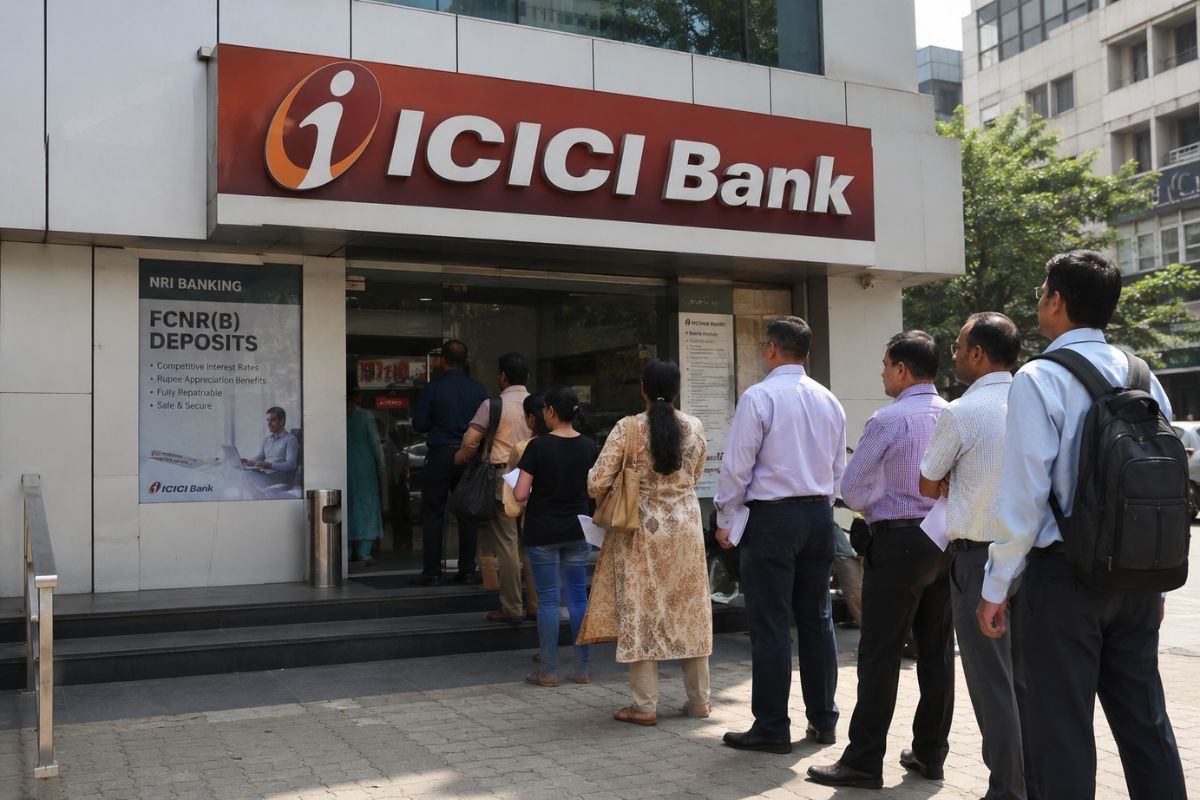
ICICI Bank mobilised $17.88 billion through the Reserve Bank of India’s foreign currency swap window, but 70.6% of these ICICI Bank FCNR(B) deposits, $12.63 billion, never entered the domestic credit market. Regulatory filings reveal the lender immediately deployed the capital to overseas branches and foreign credit instruments to capture higher offshore interest rates.
Comprehensive analysis and verified data remain essential for understanding complex market dynamics.
Clarity Times Research
Foreign Currency Non-Resident (Bank) deposits, commonly designated as FCNR(B) deposits, are fixed-term foreign currency funds deposited by non-resident Indians in domestic banks without converting the principal into Indian rupees.
Where Did ICICI Bank’s FCNR(B) Deposits Actually Go?
According to ICICI Bank’s statutory exchange filings submitted to the Bombay Stock Exchange, the National Stock Exchange of India, and the New York Stock Exchange, the bank allocated $12.63 billion of its $17.88 billion deposit total into offshore credit assets. International branch advances absorbed $9 billion, while foreign credit guarantees accounted for the remainder.
As reported in the bank’s cross-border balance-sheet notes, ICICI Bank issued $3.63 billion in foreign Standby Letters of Credit (SBLCs) to international lenders. A standby letter of Credit is a formal bank guarantee committing to pay an offshore beneficiary if a corporate borrower defaults on an underlying financial obligation.
Combined, these international commitments represent 70.6% of the bank’s ₹1.70 lakh crore raise under the concessional swap facility. That left less than a third of the mobilized capital, roughly $5.25 billion, on domestic balance sheets for onshore lending.
Did the RBI Swap Facility Permit Banks to Send Dollars Abroad?
Under central bank operating directives, the Reserve Bank of India (RBI) permitted domestic commercial lenders to route foreign currency deposits directly to their international branches without domestic liquidity penalties. The rules gave banks a direct incentive to hold dollar assets offshore.
According to the RBI’s June 2026 regulatory update, the central bank granted complete exemptions from the Cash Reserve Ratio (CRR) and Statutory Liquidity Ratio (SLR) on fresh FCNR(B) deposits with maturities between three and five years. The Cash Reserve Ratio mandates the share of deposits banks must keep as liquid cash with the central bank, while the Statutory Liquidity Ratio requires holding a minimum quota of safe government securities.
These exemptions allowed banks to deploy 100% of mobilized deposits into interest-earning assets. By matching their dollar deposit liabilities with foreign currency loans booked overseas, commercial bank treasuries also eliminated the currency conversion risk of holding unhedged rupees onshore.
Why Did ICICI Bank Choose Offshore Lending Over Domestic Credit?
ICICI Bank deployed the funds offshore because international lending yielded substantially higher net margins than the domestic Indian corporate loan market. Lending against global interest rate benchmarks generated profitable risk-adjusted spreads that domestic foreign-currency lending could not deliver.
The Secured Overnight Financing Rate (SOFR) is the broad benchmark interest rate for dollar-denominated loans, based on overnight transactions in the US Treasury repurchase market. While the RBI’s concessional swap lowered the expense of raising foreign currency, high benchmark yields linked to US SOFR offered superior margins on international syndicated loans.
By contrast, domestic corporate appetite for foreign currency loans was limited. According to research from Systematix Institutional Equities, domestic interest income expanded by only 6% to 8% across Indian lenders, while domestic credit demand expanded at 18%, compressing onshore lending spreads. The widening gap between domestic and overseas dollar returns made international deployment the most profitable balance-sheet choice.
Do These FCNR(B) Inflows Truly Strengthen India’s Foreign Reserves?
While the Reserve Bank of India registers a headline increase in gross foreign exchange reserves when deposits arrive, commercial banking data shows an equal increase in foreign claims as those dollars leave the country. The dollars legally stand pledged to international borrowers rather than remaining available as unencumbered domestic reserves.
Official bulletins from the Reserve Bank of India indicate that the domestic banking system mobilized over $65 billion in FCNR(B) deposits and $73 billion in total overseas funding during the window. These inflows provided an immediate statistical lift to India’s reported gross foreign exchange reserves.
However, commercial banking records track an offsetting outflow under the net foreign assets category. Because commercial banks immediately re-exported the liquidity into overseas loans and credit lines, the central bank accumulated equivalent forward dollar liabilities: claims that foreign depositors will reclaim at maturity.
Who Received the $9 Billion in Overseas Credit?
The $9 billion in overseas branch advances went primarily to foreign subsidiaries of large Indian conglomerates refinancing existing dollar debt rather than funding new industrial capacity. Corporate regulatory disclosures indicate that Indian multinationals used the low-cost facility to replace high-interest External Commercial Borrowings (ECBs) and overseas bonds.
External Commercial Borrowings are commercial loans raised by eligible Indian resident entities from non-resident lenders in foreign currencies. Rather than financing new capital expenditure or physical factories in India, Indian corporate groups used credit facilities arranged in financial centers like Singapore and DIFC Dubai to retire more expensive offshore debt.
This balance-sheet substitution allowed top-tier corporate borrowers to lower their borrowing costs. It did not, however, expand industrial production or generate new domestic employment within India.
What Happens When These FCNR(B) Deposits Mature in 2029?
When these three-to-five-year term deposits mature around 2029, banks must liquidate their overseas loan assets in a synchronized unwind to repay foreign depositors. This unwinding will require commercial banks to recall offshore liquidity simultaneously, transferring foreign exchange pressure back to the central bank.
According to regulatory schedules, the deposits raised under the 2026 swap facility will reach maturity between 2029 and 2031. Because ICICI Bank tied $12.63 billion of its deposit haul to multi-year foreign loan assets and guarantee facilities, honouring depositor withdrawals requires borrowers to repay those loans on schedule.
Market analysts at Systematix point out that this simultaneous maturity schedule mirrors the 2013–2016 FCNR(B) cycle. As billions in foreign currency deposits expire in close succession, the Reserve Bank of India will face a fixed deadline to unwind forward contracts and supply dollars to the market, shifting systemic liquidity pressure to the end of the decade.
Frequently Asked Questions
How much did ICICI Bank raise through the RBI FCNR(B) swap window?
According to regulatory filings submitted to stock exchanges, ICICI Bank mobilized ₹1.70 lakh crore ($17.88 billion) in Foreign Currency Non-Resident (Bank) deposits by the end of August 2026. The wider Indian banking sector mobilized more than $65 billion in FCNR(B) deposits during the same central bank programme.
Why did ICICI Bank lend over 70% of its FCNR(B) deposits abroad?
ICICI Bank deployed $12.63 billion offshore because international loans linked to the US Secured Overnight Financing Rate (SOFR) generated higher profit margins than domestic dollar-denominated corporate credit. Lending abroad also allowed the bank to match foreign currency liabilities with foreign currency assets while avoiding domestic reserve requirements.
Did ICICI Bank violate Reserve Bank of India rules by deploying funds overseas?
No. Reserve Bank of India guidelines explicitly permit domestic commercial banks to route foreign currency deposits to their overseas branches. Central bank directives also granted full exemptions from domestic Cash Reserve Ratio (CRR) and Statutory Liquidity Ratio (SLR) mandates on these deposits, making international deployment fully compliant.
What is the macroeconomic risk when these FCNR(B) deposits mature in 2029?
Because the mobilized deposits carry fixed three- to five-year tenors, their maturity creates a synchronized demand for dollar repayments between 2029 and 2031. Commercial banks will need to unwind their overseas loans and standby letters of credit on schedule, shifting currency stabilization pressure back to the Reserve Bank of India.
Editorial Independence & Corrections
Clarity Times is published by Beeps Venture Technologies LLP under strict editorial independence charters. We uphold rigorous sourcing and verification protocols. Noticed a factual omission or error? Review our Correction Protocols or contact our editorial desk at mail@claritytimes.org.

Praseetha K
Investigative journalist and research analyst contributing independent field reports and structural analysis for Clarity Times.