At Clarity Times, we examine what mainstream narratives omit. This dispatch investigates institutional incentives, policy fine print, and multi-dimensional community impacts.
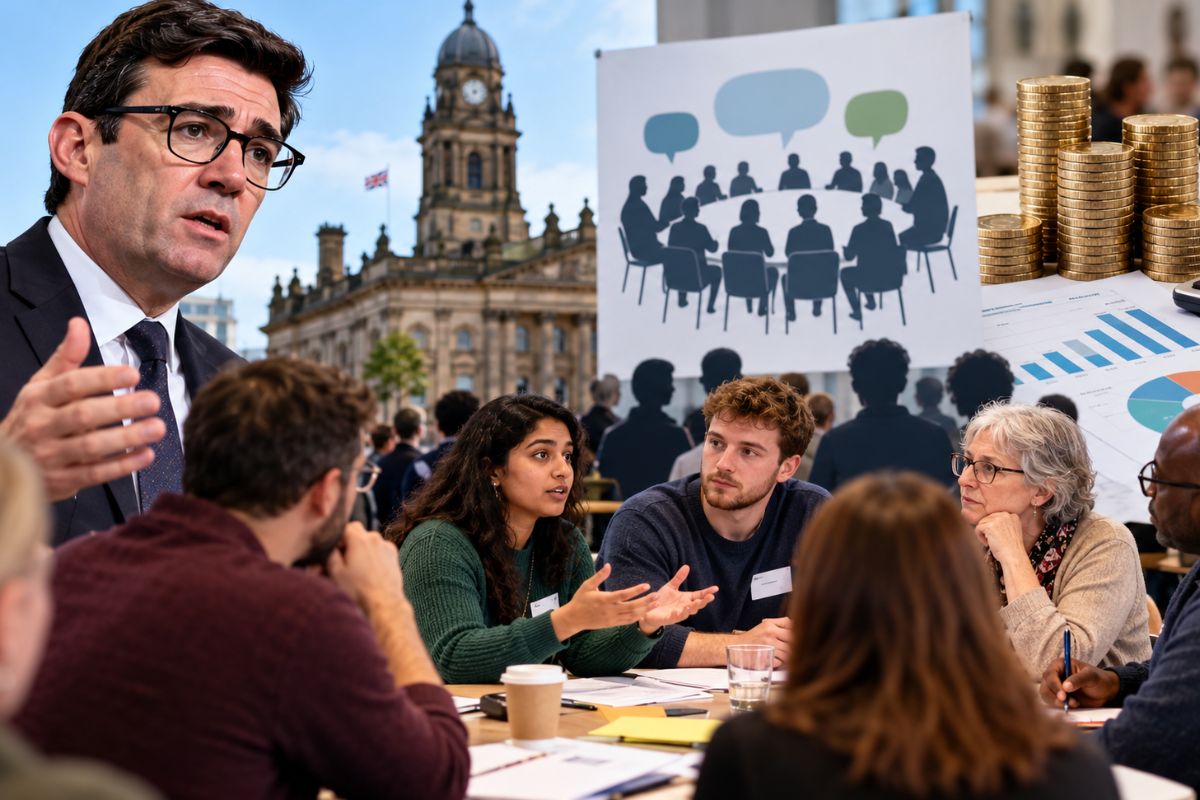
While Prime Minister Andy Burnham champions mandated citizens’ panels as a return to grassroots democracy, the financial reality tells a different story. In practice, local councils will be forced to funnel tens of millions of pounds into the hands of private contractors. Public procurement records reveal that these democratic exercises are quietly outsourced to a specialized, niche network of facilitation agencies, significantly inflating the cost of public consultation.
Who manages everyday democracy?
When a local authority convenes a panel, they hire external contractors rather than organizing it themselves. This outsourcing creates a lucrative market for professional mediators.
Agencies like Involve and the Sortition Foundation dominate the civic-consultation market. They handle the complex logistics of sortition, a process that uses algorithms to select a demographically representative group of residents randomly. These agencies execute the demographic lotteries and mediate the room before translating citizen debates into official policy recommendations.
How much will citizens’ assemblies cost taxpayers?
Establishing just one standing panel in every English local authority will cost taxpayers an estimated £47.5 million in public funding, according to cost data from facilitation agencies and government authority figures. The proposed English Devolution and Community Empowerment Bill shifts this democratic model from an occasional local experiment to a statutory requirement.
If every local authority must establish a standing panel, a permanent committee of randomly selected residents that regularly reviews local policy, the public expenditure scales immediately. England currently has 317 local authorities, according to the UK Government. Based on an indicative local assembly cost of £150,000 per event provided by Involve, creating these panels transforms a small sector of democratic facilitators into a primary beneficiary of national local government funding.
Why does the government use private contractors?
Councils must hire private contractors to run these events because government bodies are legally required to follow strict public procurement rules. They cannot simply gather residents in a town hall.
Burnham argues these assemblies are necessary to cure a “democratic doom loop”. By pushing power out of Whitehall and “into every postcode in the land,” the administration believes it can restore public trust. To execute this vision legally, councils issue formal tenders, evaluate bids from facilitation agencies, and enter into binding contracts for democratic management.
Where does the assembly budget actually go?
A line-item look at these contracts reveals a sharp split between the professionals running the event and the citizens attending it. The majority of the funding covers administrative and consulting fees.
According to Involve’s published indicative local assembly budget, a council can expect to pay participants £20,000 to £30,000 total, based on a stipend of £75 per day. The fees for professional services consume a larger share of the funds. According to the same budget, preparation and design combined with lead facilitation and support staff cost the council between £35,000 and £55,000 per assembly.
| Budget Category | Estimated Cost (Per Assembly) | Percentage of Typical £150k Budget |
|---|---|---|
| Professional Facilitation & Design | £35,000 – £55,000 | ~23% – 36% |
| Citizen Stipends (£75/day) | £20,000 – £30,000 | ~13% – 20% |
| Logistics, Venue & Misc. | Remainder | ~44% – 64% |
The facilitation agencies argue these professional fees are necessary. Representatives state that without expert management, public consultations are routinely captured by highly motivated special interest groups. Professional sortition ensures demographic fairness. Rigorous facilitation, they argue, is the only way to extract usable policy from a room of randomly selected voters.
Who is writing the new democratic rules?
The push to mandate these assemblies comes from the exact professional ecosystem that provides the services. Think tanks and advocacy groups that design the policies frequently belong to the same networks as the agencies securing the contracts.
Think tanks like Demos drafted the framework for a “new democratic operating model,” directly lobbying the Prime Minister to make standing citizens’ panels permanent infrastructure. The organizations advising the government on how to design these empowerment bills belong to the same professional network as the agencies bidding on the resulting local contracts.
Frequently Asked Questions
What is the English Devolution and Community Empowerment Bill?
The English Devolution and Community Empowerment Bill is proposed legislation under Prime Minister Andy Burnham that mandates local authorities to create permanent standing panels of citizens to guide policy. This shifts civic consultation from an optional practice to a statutory requirement across England.
How much do citizens’ assemblies cost local councils?
According to the facilitation agency Involve, a typical local citizens’ assembly costs an estimated £150,000. Of that budget, professional facilitators and support staff charge between £35,000 and £55,000, while the participating citizens receive £20,000 to £30,000 in stipends.
Who gets paid to run government citizens’ assemblies?
Local councils outsource the management of citizens’ assemblies to private contractors to comply with procurement rules. A small network of specialized facilitation NGOs and agencies, primarily Involve and the Sortition Foundation, regularly secure these public procurement contracts.
Editorial Independence & Corrections
Clarity Times is published by Beeps Venture Technologies LLP under strict editorial independence charters. We uphold rigorous sourcing and verification protocols. Noticed a factual omission or error? Review our Correction Protocols or contact our editorial desk at mail@claritytimes.org.

Praseetha K
Investigative journalist and research analyst contributing independent field reports and structural analysis for Clarity Times.