At Clarity Times, we examine what mainstream narratives omit. This dispatch investigates institutional incentives, policy fine print, and multi-dimensional community impacts.
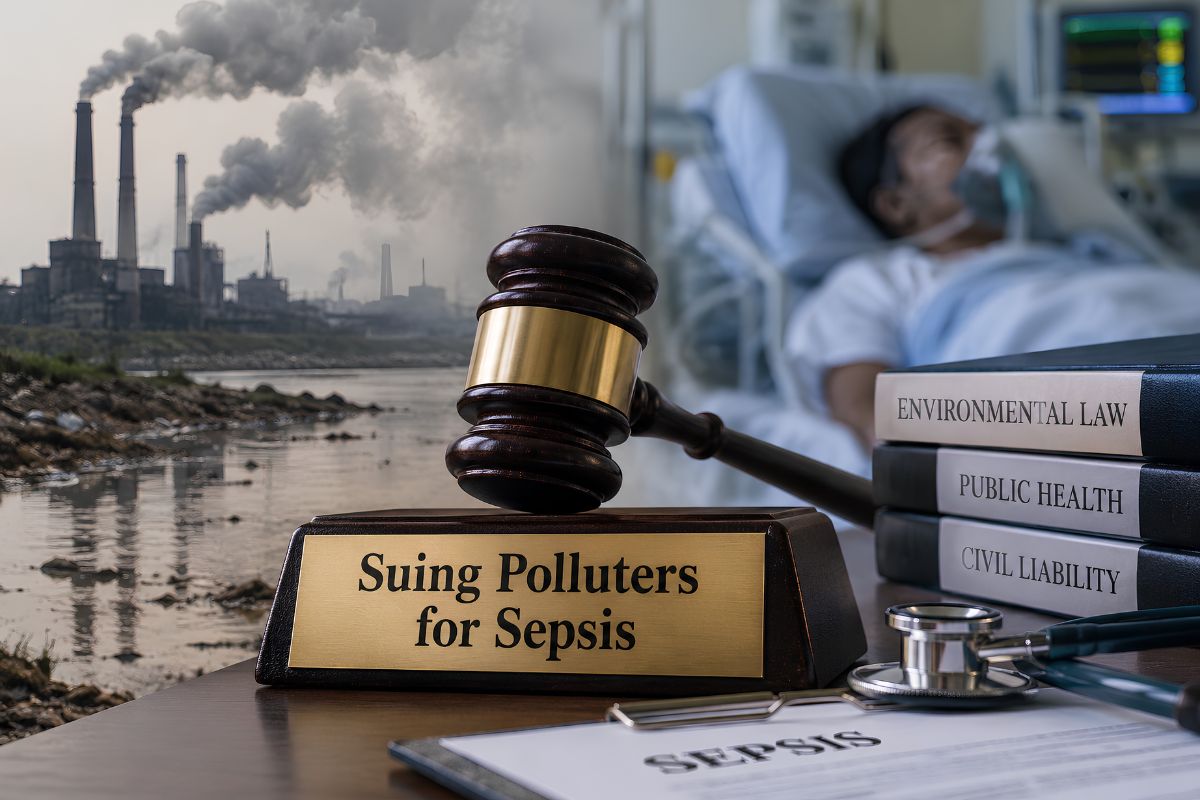
Environmental lawyers can now sue industrial polluters for sepsis and other rapid-onset bacterial infections. By leveraging a newly established 48-hour medical link between acute pollution spikes and sepsis onset, attorneys can prove direct legal causation, effectively bypassing the alternative-cause defenses that routinely defeat long-term disease claims.
How does a 48-hour pollution link change toxic tort litigation?
The 48-hour window between a pollution spike and a sepsis diagnosis provides a tight legal timeline that functionally eliminates the decades-long alternative-cause defenses used by corporate defendants.
Historically, environmental lawsuits rely on linking industrial emissions to long-term illnesses like cancer. That timeline spans decades. The medical link between pollution and sepsis shrinks that latency period to a two-day window.
Recent epidemiological data, including a major time-series analysis of hospital admissions published in PubMed Central, establishes a measurable hazard increase within 24 to 48 hours of exposure to pollutants like fine particulate matter and ozone.
This compression changes the standard of proof in civil court. In long-term toxic torts – a type of personal injury lawsuit where a plaintiff claims chemical exposure caused their illness – corporate defendants defeat claims by pointing to a plaintiff’s lifetime habits. Legal advocacy groups specializing in environmental litigation note that a 48-hour onset removes the ability to blame a plaintiff’s 20-year smoking or diet history, offering a tight timeline to prove direct liability.
Hos will lawyers prove local emissions caused a specific sepsis case?
Attorneys plan to prove causation by overlaying public facility emission breach logs from the EPA ECHO database with subpoenaed private hospital emergency room admission records.
Building these acute pollution injury claims requires a specific data-matching strategy. Lawyers will not rely on broad community health surveys. Instead, they intend to correlate two distinct sets of localized data.
The legal strategy maps public regulatory data against private medical records. Attorneys plan to pull violation logs from the Environmental Protection Agency’s Enforcement and Compliance History Online (ECHO) database. The EPA ECHO database tracks exactly when specific facilities breach their permitted emission caps.
Attorneys will then issue subpoenas for local hospital emergency room admission logs. They aim to isolate patients admitted for sepsis within 48 hours of a recorded ECHO breach at a nearby facility.
Why do traditional environmental lawsuits usually fail?
Traditional environmental lawsuits fail because courts frequently accept defense arguments that a slow-developing illness resulted from other lifestyle or environmental factors rather than a specific facility’s emissions.
This legal data-merging strategy addresses the primary failure point in traditional environmental litigation. Proving that a specific chemical caused a resident’s cancer requires meeting a strict “but-for” causation standard. Plaintiffs must show the disease would not exist but for the facility’s emissions.
Because long-term diseases develop slowly, courts frequently accept defense arguments published in legal reviews like the Harvard Law Review that a plaintiff’s illness resulted from other environmental or lifestyle factors. This latency hurdle means most long-term toxic torts fail to reach trial or end in minimal settlements. Plaintiffs struggle to trace a specific chemical exposure to an illness diagnosed years later.
How will corporate defendants fight acute infection claims?
Corporate defense attorneys will argue that sepsis is a multi-causal response to an existing infection, relying on a patient’s pre-existing comorbidities to breal the causation chain.
Industrial operators and their legal teams are anticipating this shift. Their courtroom counter-strategy targets the biological complexity of sepsis itself. Sepsis is a life-threatening medical emergency where the body’s immune response to an infection damages its own tissues.
Defense attorneys in corporate environmental litigation practices argue this multi-causal nature prevents plaintiffs from satisfying the strict “but-for” causation standard, even within a 48-hour window.
In court, defendants will argue that rapid-onset sepsis is indistinguishable from standard community-acquired infections. The defense will rely on a patient’s pre-existing comorbidities – such as advanced age, immunosuppression, or prior minor infections – to break the causation chain. The defense position maintains that a simultaneous local pollution spike does not legally override these existing medical vulnerabilities.
Who is the ideal plaintiff for a pollution-sepsis lawsuit?
The ideal test case plaintiff is a resident with no history of chronic disease or immunosuppression who developed sepsis immediately following a documented EPA compliance breach at a neighboring facility.
The viability of both the plaintiff’s 48-hour timeline and the defense’s comorbidity argument remains untested in civil court. Legal clinics and mass tort firms are currently screening for fenceline community test cases to force a judicial ruling.
An ideal plaintiff for these initial suits will be a resident with no history of immunosuppression or chronic disease, who developed sepsis immediately following a documented EPA compliance breach at a neighboring facility.
The first filings will target jurisdictions with strict state-level environmental liability statutes. These initial rulings will determine whether a two-day medical link is enough th hold a factory financially responsible for a hospital admission.
Frequently Asked Questions
What is the legal link between pollution and sepsis? Epidemiological studies show a measurable increase in sepsis hospital admissions within 48 hours of exposure to acute pollution spikes. Environmental lawyers are using this 48-hour window to prove direct legal causation in toxic tort cases, avoiding the decades-long latency periods that typically defeat cancer claims.
How do lawyers trace sepsis to a specific factory? Attorneys match public regulatory data with private medical records. They use the EPA’s ECHO database to find documented emission cap breaches, then subpoena local ER logs to find patients admitted for sepsis within 48 hours of that specific breach.
What is the corporate defense against pollution-sepsis lawsuits? Corporate defendants argue that sepsis is a complex, multi-causal immune response. They intend to use a patient’s pre-existing conditions, such as immunosuppression or prior infections, to argue the illness was community-acquired rather than caused strictly by a nearby pollution spike.
| Claim Type | Latency Period | Defendant Alternative-Cause Defenses |
|---|---|---|
| Long-Term (e.g., Cancer) | 10-30 Years | Genetics, diet, smoking, other exposures |
| Rapid-Onset (Sepsis) | 24-48 Hours | Minimal (tight timeline restricts other variables) |
Editorial Independence & Corrections
Clarity Times is published by Beeps Venture Technologies LLP under strict editorial independence charters. We uphold rigorous sourcing and verification protocols. Noticed a factual omission or error? Review our Correction Protocols or contact our editorial desk at mail@claritytimes.org.

Praseetha K
Investigative journalist and research analyst contributing independent field reports and structural analysis for Clarity Times.