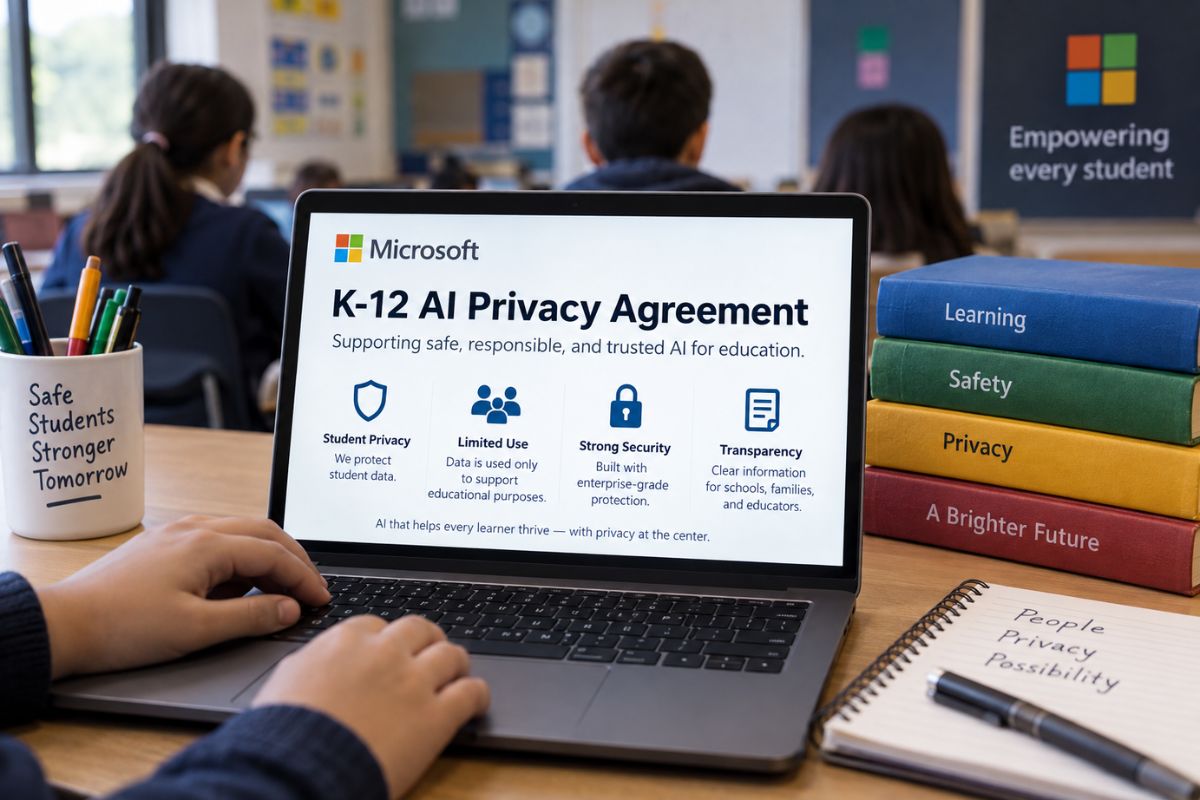
At Clarity Times, we examine what mainstream narratives omit. This dispatch investigates institutional incentives, policy fine print, and multi-dimensional community impacts.
Does the Microsoft K-12 AI privacy agreement stop the company from training artificial intelligence on student data? No. A specific “safety and security” exception in the contract legally permits Microsoft to ingest student network behavior to train its enterprise cybersecurity algorithms, rather than generative text chatbots.
What Does the Safety Exception in the Microsoft K-12 AI Privacy Agreement Allow?
The safety and security exception explicitly permits Microsoft to use student data to train, retrain, or improve artificial intelligence models built for threat detection.
Microsoft and the American Federation of Teachers (AFT) – a national labor union representing educators and school staff – published their AI Safety & Privacy Standard Fact Sheet on September 9, 2026. The first provision states that student and educator data will not be used for student data AI training.
Viewed alone, the prohibition appears complete. The full 31-page legally binding agreement explicitly permits student data to be used to train, retrain, fine-tune, evaluate, or otherwise improve artificial intelligence models.
The contract dictates this training is permissible as long as the data feeds a specific security classifier, safeguard, or threat-detection functionality.
How Do Microsoft Security AI Tools Train on Student Data?
Microsoft security AI tools train on datasets of active network telemetry from K-12 users to detect anomalies, malware, and malicious activity.
When school districts evaluate artificial intelligence, they usually focus on generative text chatbots. Microsoft’s enterprise security architecture relies on a different category of machine learning.
Tools like Security Copilot for schools detect anomalies, malware, and flagged content. Microsoft Security Copilot is an enterprise cybersecurity software suite that uses artificial intelligence to identify cyber threats. These systems do not generate essays. They analyze network traffic and user behavior to identify malicious activity.
Training these security models requires massive datasets of active network telemetry. Telemetry refers to the automated collection and transmission of data from remote computer networks.
| AI Application Type | Student Data Allowed for Training? | Primary Function |
|---|---|---|
| Generative AI (Chatbots) | No | Creating text, essays, and educational content |
| Security AI (Threat Detection) | Yes (via Safety Exception) | Identifying anomalies, malware, and abuse |
Under the contract’s definitions, Microsoft retains the right to process telemetry data for security, reliability, debugging, and product improvements. Microsoft asserts that such data ingestion is necessary to protect school networks from ransomware, grooming, and abusive content.
Do School Districts Know About the School AI Safety Exception?
School districts risk adopting the standard based on an incomplete reading of its technical limits, as the union presentation framed the deal as a total ban on data training.
AFT President Randi Weingarten introduced the AFT Microsoft AI privacy standard by presenting it as a total safeguard for students and families. According to September 2026 reporting by Quartz, Weingarten told reporters that the groups forged an iron-clad privacy agreement with real teeth that protects students and families.
This presentation shapes how districts evaluate the contract as they review the terms ahead of the November 1, 2026, effective date. If procurement officers do not distinguish between generative AI and security AI, they adopt the standard based on an incomplete reading of its technical limits.
Advocacy groups like Fairplay for Kids warn that the agreement places an unfair burden on schools to interpret and enforce the contract. Fairplay for Kids is a nonprofit advocacy organization working to protect children from commercial corporate marketing. They argue this could fool districts into thinking AI products are entirely walled off from their data.
According to a September 2026 statement from labor experts at Cornell University, the deal leaves the biggest questions about district-level AI implementation unanswered.
Will Student Data Feed Global Microsoft AI Models?
If Microsoft pools this data, student interactions could actively feed the commercial threat-detection models Microsoft sells to corporate clients worldwide.
The technical impact of the safety exception depends on where the data goes. Network telemetry can be processed locally within a single school district, or it can be aggregated globally.
The agreement allows Microsoft to use student data to identify threats like child exploitation and bullying. Threat-detection algorithms require broad exposure to recognize new patterns. This means security data is inherently designed to be pooled.
The AFT defends its tech partnerships as a strategic necessity to ensure educators influence AI development, stating they engage with eyes wide open.
A gap remains between the privacy promised in the press conference and the active algorithmic training permitted in the contract.
Frequently Asked Questions
Does the new Microsoft agreement ban all AI training on student data? No. The Microsoft K-12 AI privacy agreement includes a “safety and security exception.” This clause permits Microsoft to train cybersecurity and threat-detection AI models using student network behavior, even though it bans training generative text chatbots on student data.
When does the Microsoft K-12 AI privacy agreement take effect? The agreement becomes available for school districts to incorporate into their Microsoft contracts starting November 1, 2026. Districts must actively adopt the standard; it does not apply automatically.
What kind of student data does Microsoft use for security AI training? Microsoft uses active network telemetry to train systems like Security Copilot for schools. This includes automated data from school networks that helps algorithms identify anomalies, malware, cyber threats, and abusive content.
How did the American Federation of Teachers describe the agreement? AFT President Randi Weingarten publicly described the AFT Microsoft AI privacy standard as an iron-clad agreement that protects students from AI data extraction. The union’s presentation did not highlight the technical exception for enterprise security training.
Editorial Independence & Corrections
Clarity Times is published by Beeps Venture Technologies LLP under strict editorial independence charters. We uphold rigorous sourcing and verification protocols. Noticed a factual omission or error? Review our Correction Protocols or contact our editorial desk at mail@claritytimes.org.

Praseetha K
Investigative journalist and research analyst contributing independent field reports and structural analysis for Clarity Times.