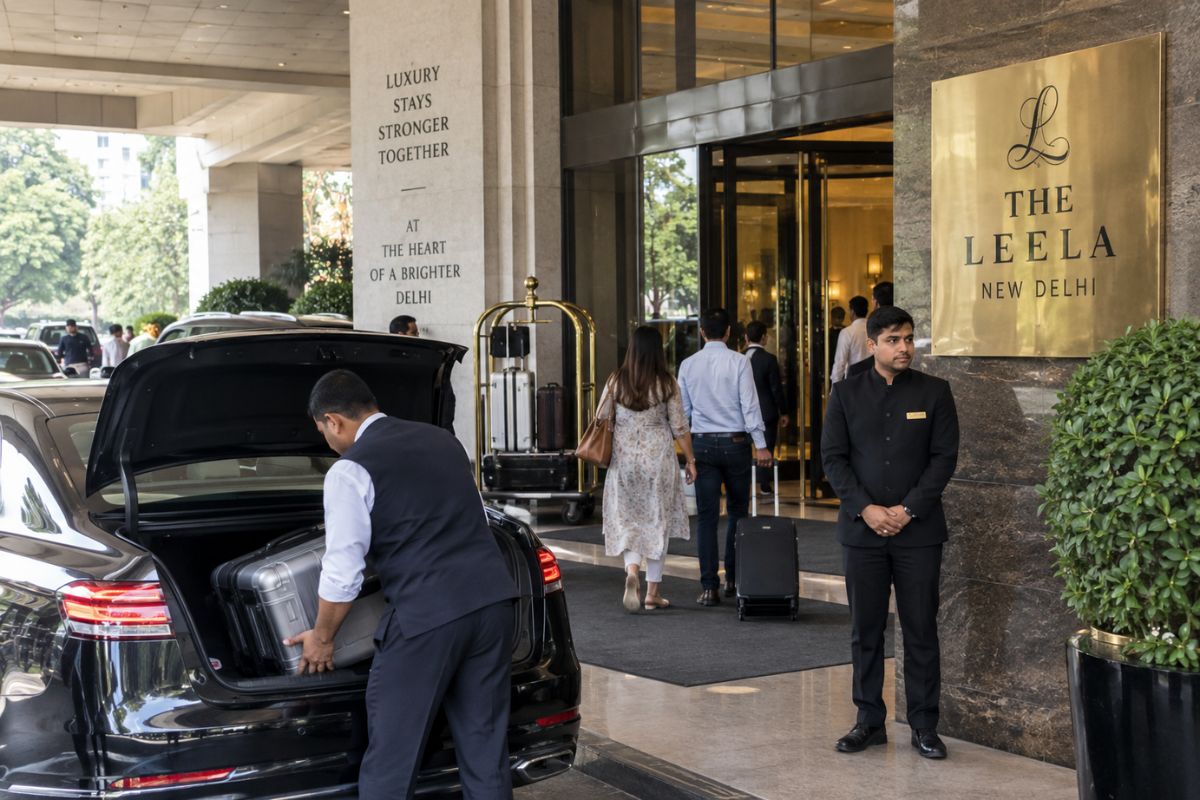
At Clarity Times, we examine what mainstream narratives omit. This dispatch investigates institutional incentives, policy fine print, and multi-dimensional community impacts.
Despite breathless media reports of BRICS and G20 room rates rocketing past ₹2.5 lakh per night, Delhi’s ultra-luxury hotels do not actually achieve record net profitability during massive international diplomatic summits. Extreme summit security cordons strictly ban all non-resident visitors, effectively wiping out the properties’ commercial restaurant and banquet operations. Because high-margin food and beverage sales historically account for nearly 45% of total turnover, these rigid, security-mandated closures severely compress overall operating margins.
How much of Delhi luxury hotel revenues come from food and beverage?
Food and beverage operations predictably generate roughly 43% of total revenue for Indian luxury hotels, meaning astronomical room rates only tell half the financial story.
While spot room rates crossing ₹2.5 lakh per night dominate summit headlines, a luxury hotel’s balance sheet fundamentally relies on two synchronized engines: room inventory and non-resident dining.
According to a definitive hospitality industry report published by HVS and the Federation of Hotel & Restaurant Associations of India (HVS-FHRAI), food and beverage operations—encompassing everything from lavish banquets to fine-dining restaurants—generate 42.6% of gross turnover for Indian premium hotels. The moment a summit locks down a property, that massive second engine grinds to a complete halt.
| Revenue Stream | Standard Commercial Operations | Summit Lockdown Conditions |
|---|---|---|
| Room Occupancy | Dynamic retail pricing (~70% occupancy) | Diplomatic block-booking (~100% occupancy) |
| Food & Beverage | High-margin public dining & alcohol | Fixed-rate delegation catering |
| Banquet / Events | High-yield corporate/wedding bookings | Cancelled or converted to buffer zones |
| Non-Resident Footfall | Open access to spas, gyms, cafes | Strictly barred by sterile security perimeter |
“For us, the ratio has moved from 35 per cent to 40 per cent on an overall basis,” noted Kapil Chopra, former president of The Oberoi Group, explicitly confirming how food and beverage operations ultimately dictate overall luxury property revenues.
Did G20 hotel profits match the surge in room rates?
No. G20 hotel profits failed to match the staggering 60% surge in room rates simply because total revenue per available room slammed into a hard ceiling when non-resident dining collapsed.
The stark financial mechanics of a diplomatic lockdown are permanently on the public record. Following the September 2023 G20 summit, quarterly operational metrics starkly revealed the margin drag.
Data synthesized from hospitality consultancy HVS Anarock showed that while New Delhi room rates leaped 60% year-on-year—pushing average daily rates (ADR, the standard metric tracking average rental income per paid occupied room) from ₹7,000 to over ₹11,000—overall property yields faced an insurmountable ceiling.
Peak summit rates briefly hit ₹26,000, yet total revenue per available room (TRevPAR, a holistic metric tracking all guest spend including food, events, and spa services) failed to scale proportionally because the restaurants sat completely empty of high-spending locals.
The Hotel Association of India (HAI) steadfastly maintains that summit hosting provides long-term commercial upside. Industry representatives argue that 100% room occupancy at premium tariffs delivers massive gross revenues that absorb these ancillary shortfalls. They logically point out that serving global heads of state generates incalculable branding equity.
How does Delhi Police summit security affect hotel dining?
Delhi Police summit security protocols mandate sterile perimeters that legally and physically bar non-resident guests from entering hotel restaurants, spas, and coffee shops.
Multilateral summits involving high-risk world leaders require hermetically sealed security envelopes. The Ministry of External Affairs (MEA) and Delhi Police actively treat commercial dining disruption as a standard, non-negotiable operational requirement to ensure zero security incidents.
During the G20, Special Commissioner of Police SS Yadav confirmed the ruthless closure of commercial delivery services, markets, and cloud kitchens across the entire New Delhi district.
Inside the perimeter, hotel operations shifted entirely to defense protocols. Properties formally wrote to their high-paying regular club members stating that gyms, spas, restaurants, and coffee shops were absolutely off-limits to outsiders.
Why do hotel banquet cancellations spike during international summits?
Hotel banquet cancellations aggressively spike because impenetrable police cordons physically prevent private guests from reaching the venue, forcing the painful relocation of highly profitable weddings and corporate meetings.
The absolute restriction on non-resident entry forces the immediate relocation of pre-booked weddings, corporate board meetings, and massive weekend banquets.
A private 300-person banquet hall booking equipped with full alcohol licensing yields exceptionally high gross margins. During a summit, that exact same hall is forcibly converted into an administrative buffer zone for diplomatic delegations, entirely stripping out the lucrative retail element.
Travel Boutique Online executive Ankush Nijhawan previously noted that severe capacity constraints during these summits leave the open market desperately scrambling for alternative venues.
Are diplomatic delegation meals profitable for luxury hotels?
Diplomatic meals are significantly less profitable than standard commercial dining because government missions aggressively negotiate fixed-rate, often alcohol-free packages well below standard luxury restaurant markups.
Government delegations categorically do not order a la carte from standard restaurant menus. State missions leverage their volume to negotiate fixed-rate banquet and catering packages well in advance of the actual event.
These packages run on tightly controlled, state-mandated per-head caps. During the 2023 summit, for example, hotels replaced standard high-end dining with specialized Indian thalis and fixed, budget-conscious millet-based menus.
Commercial dining operates with enormous standard hospitality markups, often exceeding 200% on imported alcohol. By swapping high-spending regular diners for austere state delegations, the hotel serves similar food volumes but realizes only a fraction of the profit margin per cover.
Which hotels actually make the most money during Delhi summits?
Outer-ring properties located in Aerocity and Gurugram realize the highest net margins because they eagerly absorb displaced corporate travelers at elevated rates without facing any security-mandated restaurant closures.
The true, immediate financial beneficiaries of diplomatic mega-events sit comfortably outside the sterile summit security perimeter.
Corporate travelers and airline crews holding long-term contracts are forcefully displaced from central Delhi. They route directly to secondary hub properties. Operational data proves that hotels in Aerocity and South Delhi immediately hit capacity during the G20.
These outer-ring hotels successfully capture the massive surge in corporate demand at elevated, dynamic room rates. Critically, they do so without incurring any security-mandated closures, allowing their high-margin restaurants and banquet halls to operate at absolute peak commercial capacity.
Frequently Asked Questions
Why do Delhi luxury hotel rooms cost ₹2.5 lakh during summits?
The extreme rates apply only to the very last handful of unreserved rooms. Embassies and the Ministry of External Affairs block-book 80% to 90% of the inventory months in advance at standard, negotiated diplomatic rates, leaving dynamic retail pricing algorithms to push the final few rooms past the ₹2.5 lakh threshold.
Do luxury hotels lose money during diplomatic summits?
No, they do not face operational insolvency, but their net margins compress significantly. The massive top-line revenue generated by 100% room occupancy is heavily offset by the forced closure of commercial restaurants and banquets, which typically account for over 40% of their total business.
Can I visit a Delhi 5-star hotel restaurant during a summit?
No. Delhi Police security protocols establish impenetrable sterile zones around summit hotels, and internal hotel memos explicitly ban all non-resident guests from accessing restaurants, bars, gyms, and spas during the duration of the event.
Editorial Independence & Corrections
Clarity Times is published by Beeps Venture Technologies LLP under strict editorial independence charters. We uphold rigorous sourcing and verification protocols. Noticed a factual omission or error? Review our Correction Protocols or contact our editorial desk at mail@claritytimes.org.

Praseetha K
Investigative journalist and research analyst contributing independent field reports and structural analysis for Clarity Times.